 by Nayeghar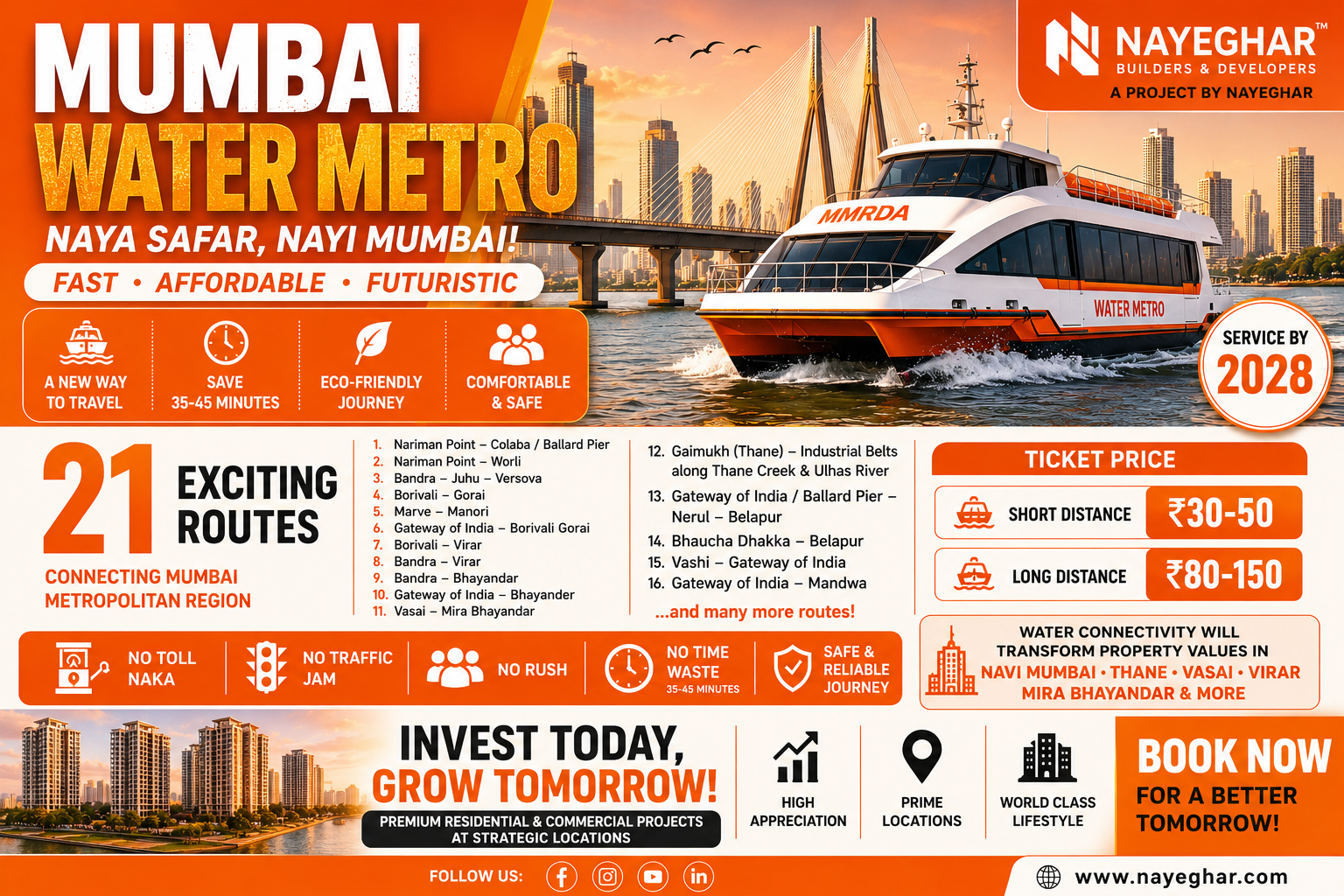
Mumbai, often called the financial capital of India, is home to more than 20 million people and witnesses massive traffic congestion every day. With roads and railways operating under immense pressure, the need for alternative and efficient transportation has become more important than ever. To address this challenge, the Mumbai Metropolitan Region Development Authority (MMRDA) is planning an ambitious Mumbai Water Metro Project, which aims to revolutionize urban transportation by utilizing the city’s vast coastline and waterways.
Expected to become operational by 2028, the Mumbai Water Metro will provide fast, affordable, eco-friendly, and comfortable travel options across Mumbai, Navi Mumbai, Thane, Vasai-Virar, and surrounding regions. Similar to the successful Kochi Water Metro model, Mumbai’s water-based transport system is expected to transform commuting and boost infrastructure development and real estate growth.
What is Mumbai Water Metro?
Mumbai Water Metro is a modern ferry-based public transportation system designed to connect various parts of the Mumbai Metropolitan Region (MMR) through waterways. The project will utilize the Arabian Sea, Thane Creek, and Ulhas River to create a network of high-speed ferries and terminals.
The project aims to reduce dependency on roads and suburban railways while providing a faster and more sustainable mode of transport.
Objectives of Mumbai Water Metro
The main objectives behind the project include:
- Reducing road traffic congestion.
- Offering faster travel between Mumbai and Navi Mumbai.
- Creating an environmentally friendly transport network.
- Improving connectivity between business hubs and residential areas.
- Promoting tourism and waterfront development.
- Supporting economic growth and real estate appreciation.
Proposed Water Metro Routes
MMRDA is reportedly considering around 21 routes across the Mumbai Metropolitan Region.
1. Nariman Point – Colaba – Ballard Pier
This route will connect South Mumbai’s business districts and tourist destinations.
2. Nariman Point – Worli
Providing quick connectivity between commercial centers.
3. Bandra – Juhu – Versova
A major route for western suburbs residents.
4. Borivali – Gorai
Enhancing connectivity to recreational areas.
5. Marve – Manori
Beneficial for local residents and tourists.
6. Gateway of India – Borivali Gorai
Connecting South Mumbai with northern suburbs.
7. Borivali – Virar
Reducing travel time for commuters from Virar.
8. Bandra – Virar
Providing an alternative to overcrowded local trains.
9. Bandra – Bhayandar
Helping commuters avoid heavy highway traffic.
10. Gateway of India – Bhayandar
Creating direct access from South Mumbai.
11. Vasai – Mira Bhayandar
Strengthening connectivity in the northern region.
12. Gaimukh (Thane) – Industrial Belt
Using Thane Creek and Ulhas River routes.
13. Gateway of India / Ballard Pier – Nerul – Belapur
Providing direct connectivity between Mumbai and Navi Mumbai.
14. Bhaucha Dhakka – Belapur
Reducing commuting time for office-goers.
15. Vashi – Gateway of India
One of the most significant routes for daily commuters.
16. Gateway of India – Mandwa
Supporting tourism and leisure travel.
Many additional routes are expected to be added in future phases.
Ticket Prices
According to preliminary estimates, the ticket prices are expected to remain affordable.
Short Distance Routes
₹30 to ₹50
Long Distance Routes
₹80 to ₹150
This pricing structure makes Water Metro an economical alternative compared to private vehicles and taxis.
Key Features of Mumbai Water Metro
Fast Travel
Journey times are expected to range between 35 and 45 minutes, significantly reducing travel duration.
Zero Traffic Congestion
Since ferries operate on water routes, commuters can avoid traffic jams.
No Toll Charges
Travelers will not have to pay toll taxes, unlike road transportation.
Eco-Friendly Transportation
Modern ferries are expected to reduce carbon emissions and support sustainable urban mobility.
Comfortable Journey
Passengers will enjoy:
- Air-conditioned cabins
- Comfortable seating
- Safety systems
- Modern terminals
- Digital ticketing facilities
Reliable Service
Water transport offers predictable travel schedules with minimal delays.
Environmental Benefits
One of the biggest advantages of the Water Metro is its contribution toward sustainable development.
Reduced Carbon Emissions
Fewer cars on roads will lead to lower pollution levels.
Less Fuel Consumption
Water transport consumes less energy per passenger compared to road vehicles.
Cleaner Urban Environment
Reduced traffic means better air quality and lower noise pollution.
Impact on Tourism
Mumbai is famous for its coastline and historical attractions. Water Metro will significantly improve access to:
- Gateway of India
- Mandwa Beach
- Alibaug
- Elephanta Caves
- Marine Drive
- Colaba
- Gorai Beach
- EsselWorld Region
Tourism activities and weekend travel are expected to increase considerably.
Impact on Navi Mumbai
Navi Mumbai stands to benefit enormously from this infrastructure project.
Major areas likely to witness improved connectivity include:
Belapur
Business district with strong commercial potential.
Nerul
A prime residential and educational hub.
Vashi
One of Navi Mumbai’s most developed areas.
Kharghar
Rapidly emerging residential destination.
Ulwe
Benefiting from Navi Mumbai International Airport and MTHL connectivity.
Panvel
Future infrastructure powerhouse.
Improved accessibility usually leads to higher property demand and better appreciation.
Impact on Real Estate Market
Infrastructure projects have historically increased property values.
The Water Metro project is expected to positively influence:
Navi Mumbai
- Belapur
- Nerul
- Vashi
- Ulwe
- Kharghar
- Panvel
Thane Region
- Gaimukh
- Ghodbunder Road
- Kasarvadavali
Mira Bhayandar
Increasing residential demand.
Vasai-Virar
Improved connectivity may boost housing and commercial developments.
Advantages for Property Buyers
- Higher capital appreciation.
- Better rental demand.
- Improved quality of life.
- Enhanced connectivity to business districts.
- Increased employment opportunities.
Integration with Other Mega Projects
Mumbai Water Metro will complement several ongoing infrastructure developments:
Mumbai Trans Harbour Link (MTHL)
Connecting Mumbai and Navi Mumbai.
Navi Mumbai International Airport
Expected to become operational soon.
Mumbai Metro Network
Providing seamless multimodal connectivity.
Coastal Road Project
Reducing travel time across Mumbai.
Dedicated Freight Corridors
Supporting industrial and logistics growth.
Together, these projects are transforming Mumbai into one of India’s most advanced metropolitan regions.
Challenges Ahead
Despite its advantages, some challenges remain:
- Construction of terminals and jetties.
- Environmental clearances.
- Weather conditions during monsoon seasons.
- Integration with existing transport networks.
- Operational and maintenance costs.
However, with proper planning and advanced marine technology, these challenges can be addressed effectively.
Future Prospects
By 2028, Mumbai Water Metro could emerge as one of India’s most advanced water transport systems. The project is expected to:
- Reduce traffic congestion.
- Improve daily commuting.
- Promote sustainable transportation.
- Increase tourism activities.
- Strengthen the real estate market.
- Generate employment opportunities.
- Enhance economic growth across the Mumbai Metropolitan Region.
Conclusion
Mumbai Water Metro is much more than a transportation project—it represents a new era in urban mobility. As Mumbai continues to grow, innovative solutions like water-based transportation are essential for maintaining efficiency and improving quality of life.
For residents of Mumbai, Navi Mumbai, Thane, Vasai-Virar, and surrounding regions, the Water Metro promises faster travel, better connectivity, and new investment opportunities. Combined with projects like MTHL and Navi Mumbai International Airport, it is expected to redefine the future of the Mumbai Metropolitan Region and contribute significantly to the growth of the real estate sector.