 by Nayeghar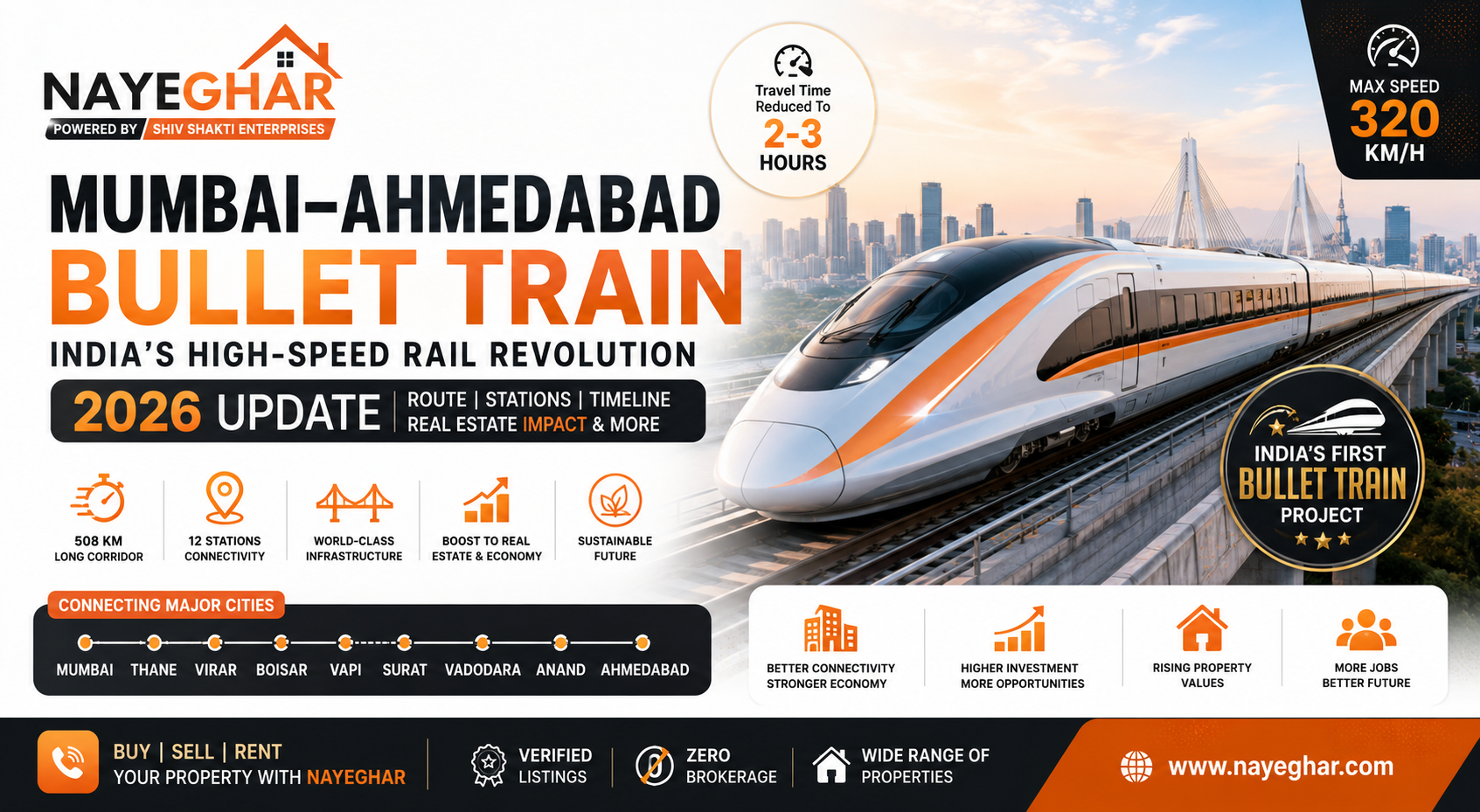
Mumbai–Ahmedabad Bullet Train 2026: Complete Guide to India’s First Bullet Train Project
India is rapidly moving towards a new era of transportation with the Mumbai–Ahmedabad High-Speed Rail (MAHSR) project. This is India’s first bullet train corridor and one of the country’s most ambitious infrastructure developments. Designed with Japanese Shinkansen technology, the project promises to transform travel, boost economic growth, create employment, and significantly increase the value of real estate along its route.
A recent development has attracted nationwide attention. Reports indicate that the initial operations of the Mumbai–Ahmedabad Bullet Train may begin with Indian high-speed trainsets before Japan’s next-generation E10 Shinkansen becomes available in the early 2030s. This reflects India’s commitment to launching the project on schedule while continuing its technology partnership with Japan.
What is the Mumbai–Ahmedabad Bullet Train Project?
The Mumbai–Ahmedabad High-Speed Rail Corridor is India’s first bullet train project connecting Mumbai in Maharashtra with Ahmedabad in Gujarat.
The corridor has been designed using Japanese Shinkansen technology, which has one of the best safety records in the world. The project aims to provide world-class transportation with faster travel, improved connectivity, and economic development.
Project Highlights
- Total Corridor Length: Approximately 508 km
- Maximum Speed: 320 km/h
- Operational Speed: Around 320 km/h
- Estimated Travel Time: Around 2–3 hours
- Current Travel Time by Train: 6–8 hours
- Technology Partner: Japan
- Executing Agency: National High Speed Rail Corporation Limited (NHSRCL)
Mumbai–Ahmedabad Bullet Train Route
The high-speed rail corridor connects:
- Mumbai
- Thane
- Virar
- Boisar
- Vapi
- Bilimora
- Surat
- Bharuch
- Vadodara
- Anand
- Ahmedabad
- Sabarmati
These locations are expected to witness major economic and infrastructure growth over the next decade.
Bullet Train Stations
The project includes multiple modern stations featuring:
- Airport-style security
- Smart ticketing
- Digital passenger information systems
- Premium waiting lounges
- High-speed internet
- Retail and food courts
- Multi-level parking
- Metro and city transport connectivity
Latest 2026 Update
One of the biggest announcements is that India is considering operating indigenous high-speed trainsets during the initial phase.
Japan’s advanced E10 Shinkansen is still under development and is expected to become operational in the early 2030s.
This means passengers may experience India’s first bullet train services even before the E10 trains are introduced.
This approach allows India to begin operations while maintaining long-term cooperation with Japan.
Construction Progress
Major work has already been completed across Gujarat and Maharashtra.
Current progress includes:
- Hundreds of bridge structures completed
- Large sections of viaduct construction finished
- River bridges under construction
- Station buildings progressing rapidly
- Track installation beginning in completed sections
- Depot construction advancing
- Electrical systems under development
The project is one of India’s fastest-moving mega infrastructure developments.
Japan’s E10 Shinkansen
Japan is developing the next-generation E10 Shinkansen with advanced technology such as:
- Improved energy efficiency
- Enhanced earthquake safety
- Lower maintenance costs
- More comfortable passenger cabins
- Advanced AI-based monitoring
- Better aerodynamics
- Quieter operations
India is expected to adopt these technologies in future phases.
Benefits of the Bullet Train
Faster Travel
The journey between Mumbai and Ahmedabad will reduce dramatically compared to conventional rail.
Better Business Connectivity
Business travelers will be able to make same-day return trips.
Tourism Growth
Tourism across Maharashtra and Gujarat will receive a significant boost.
Employment Generation
Thousands of direct and indirect jobs are being created through construction and operations.
Technology Transfer
India gains valuable expertise in high-speed rail engineering and infrastructure.
Real Estate Impact
Infrastructure projects have historically increased property demand, and the bullet train corridor is expected to create similar opportunities.
Areas likely to benefit include:
Mumbai
Commercial and premium residential developments are expected to strengthen.
Thane
Improved connectivity may further enhance demand for housing and offices.
Virar
Affordable housing and township projects could see increased interest.
Boisar
Industrial expansion and residential demand may grow.
Vapi
Manufacturing and logistics investments could accelerate.
Surat
Luxury apartments, commercial offices, and retail projects may benefit.
Bharuch
Industrial and warehousing sectors may expand.
Vadodara
Residential and commercial property values may rise due to improved accessibility.
Anand
Educational and residential infrastructure may develop further.
Ahmedabad
Premium commercial hubs and residential projects are expected to witness sustained demand.
Why Investors Should Watch This Corridor
Infrastructure-led development often attracts:
- Residential projects
- Commercial complexes
- Office spaces
- Retail malls
- Hotels
- Warehousing
- Logistics parks
- Mixed-use developments
Property values near transport infrastructure generally appreciate over time, although actual returns depend on market conditions and project completion.
Economic Impact
The project is expected to:
- Increase regional GDP
- Encourage industrial investments
- Improve logistics efficiency
- Support tourism
- Generate employment
- Strengthen the Make in India initiative
- Promote smart city development
Engineering Excellence
The project incorporates advanced engineering features such as:
- Elevated viaducts
- Long bridges
- High-speed rail tracks
- Modern signaling systems
- Automatic train protection
- Earthquake detection systems
- Advanced communication networks
Sustainability
The bullet train project also focuses on:
- Lower carbon emissions
- Reduced dependence on road transport
- Energy-efficient operations
- Sustainable infrastructure development
Challenges
Like any mega infrastructure project, challenges include:
- Land acquisition
- Environmental clearances
- Utility shifting
- Complex engineering work
- Large-scale financing
- Coordination across multiple agencies
Despite these challenges, construction continues to progress.
Investment Opportunities
Real estate investors may consider monitoring:
- Residential apartments
- Affordable housing
- Premium housing
- Commercial offices
- Industrial land
- Logistics parks
- Warehouses
- Retail properties
Investors should evaluate location, connectivity, legal approvals, and market demand before making investment decisions.
Future Outlook
The Mumbai–Ahmedabad Bullet Train is expected to redefine transportation in India and lay the foundation for future high-speed rail corridors across the country.
As construction advances, the project is likely to become a catalyst for economic growth, infrastructure development, and real estate appreciation in several cities.
Frequently Asked Questions (FAQ)
When will the Mumbai–Ahmedabad Bullet Train start?
The first operational section is targeted to open in phases as construction milestones are achieved.
What is the maximum speed?
The trains are designed to operate at speeds of up to 320 km/h.
How long is the corridor?
Approximately 508 kilometres.
Which cities are connected?
Mumbai, Thane, Virar, Boisar, Vapi, Bilimora, Surat, Bharuch, Vadodara, Anand, Ahmedabad, and Sabarmati.
Will property prices increase?
Major transport infrastructure often improves connectivity and can increase demand for nearby residential and commercial properties, though outcomes vary by location and market conditions.
Conclusion
The Mumbai–Ahmedabad Bullet Train is more than just a transportation project—it represents India’s vision for modern infrastructure, faster connectivity, and long-term economic growth. With construction progressing steadily and high-speed rail technology being introduced, the corridor is expected to reshape travel, business, tourism, and real estate across western India.
For property buyers and investors, the cities along the bullet train route deserve close attention over the coming years as improved connectivity has the potential to influence development patterns and investment opportunities.
Source: Official project updates from NHSRCL and recent public reports on the Mumbai–Ahmedabad High-Speed Rail project.