 by Nayeghar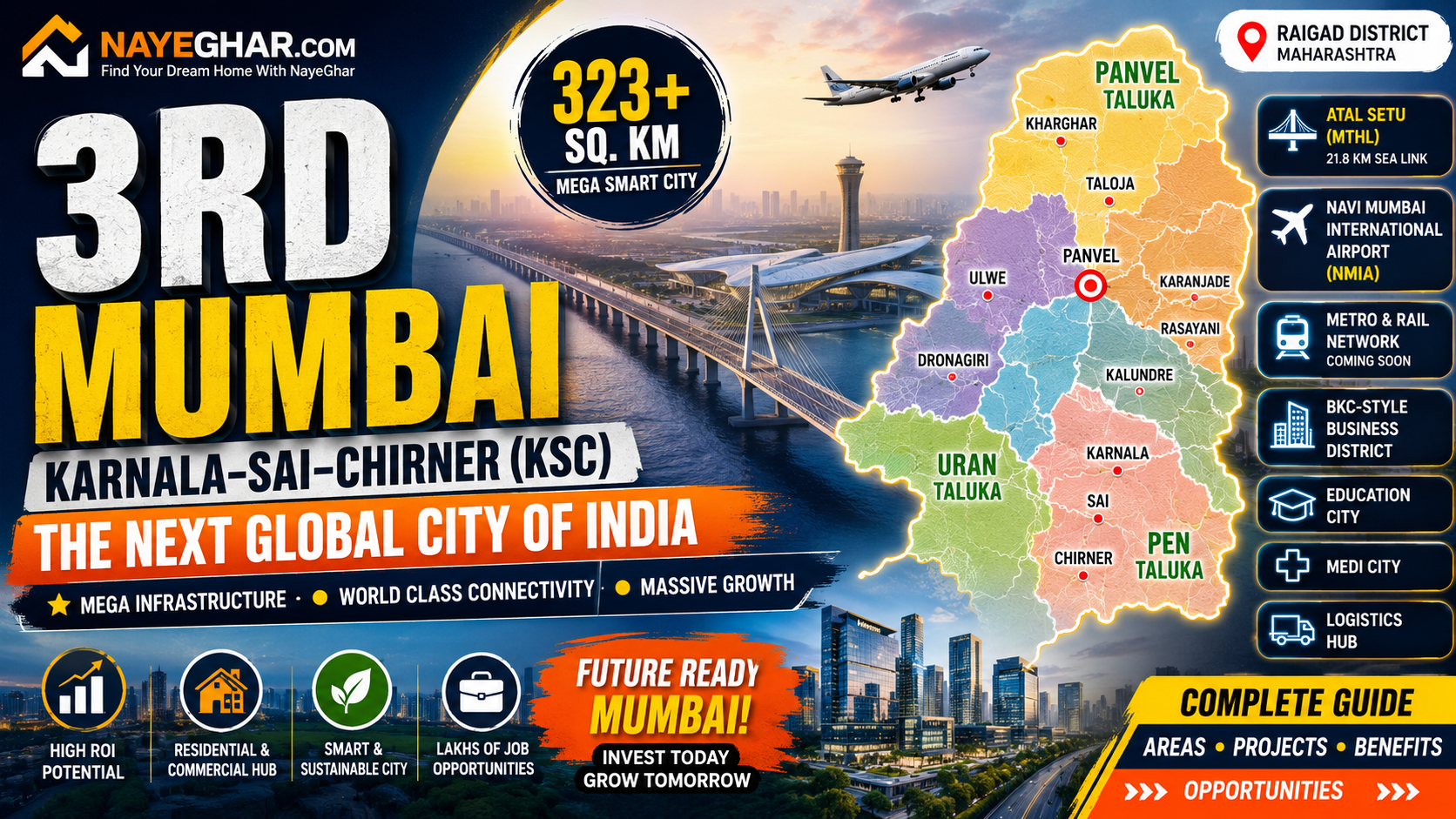
The Mumbai Metropolitan Region (MMR) is entering a new era of urban development. After the success of Mumbai and Navi Mumbai, the Maharashtra Government has unveiled Third Mumbai, officially known as Karnala-Sai-Chirner (KSC) New Town. This mega smart city is expected to become India’s next business, financial, technology, education, and logistics hub.
Spread across approximately 323 sq. km in Raigad district, Third Mumbai is being planned as a futuristic city with world-class infrastructure, smart mobility, sustainable development, and globally competitive business districts. The project is led by the Mumbai Metropolitan Region Development Authority (MMRDA) and is expected to transform the real estate landscape of Navi Mumbai and surrounding regions over the next two decades.
What is Third Mumbai?
Third Mumbai, officially named Karnala-Sai-Chirner (KSC) New Town, is Maharashtra’s newest planned city located around the influence zone of:
- Navi Mumbai International Airport (NMIA)
- Atal Setu (Mumbai Trans Harbour Link)
- NAINA Region
- JNPT Port
- Dedicated Freight Corridors
- Upcoming Metro Network
- Mumbai Suburban Railway Extension
The vision is simple:
Create India’s smartest economic city that supports the future growth of Mumbai Metropolitan Region.
Why is Third Mumbai Being Developed?
Mumbai has limited land for future expansion.
Navi Mumbai solved part of this challenge.
Now, with:
- Population Growth
- Airport Development
- Atal Setu
- Industrial Expansion
- Increasing Global Investments
the government needs another planned urban city.
Third Mumbai is designed to:
- Reduce pressure on Mumbai
- Create millions of jobs
- Attract multinational companies
- Build affordable and premium housing
- Develop global education and healthcare infrastructure
- Become Maharashtra’s next financial capital
Official Name: KSC New Town
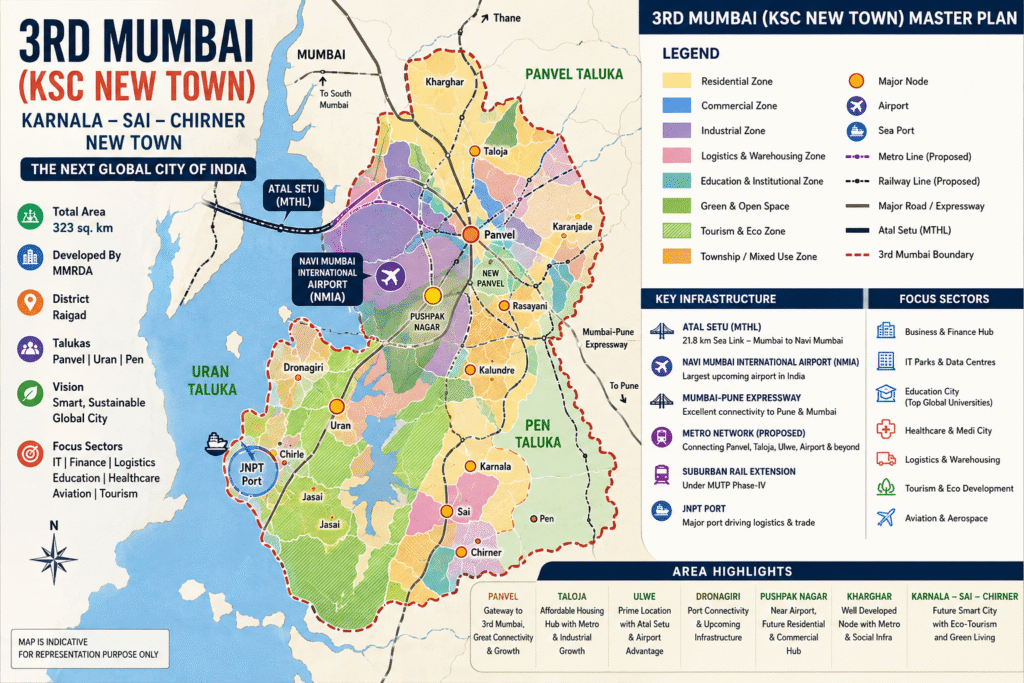
On 21 October 2024, MMRDA officially renamed Third Mumbai as:
Karnala-Sai-Chirner (KSC) New Town
The name is derived from three historic villages:
- Karnala
- Sai
- Chirner
This reflects the region’s cultural identity while positioning it as a modern smart city.
Total Area of Third Mumbai
Approximately
323 Square Kilometres
This makes it almost three times larger than South Mumbai.
Chief Minister Devendra Fadnavis has described the project as:
“The Next Business Capital of India.”
Areas Included in Third Mumbai
The city covers major parts of:
Panvel Taluka
- Panvel
- New Panvel
- Taloja
- Karanjade
- Kalundre
- Rasayani
- Roadpali
- Kamothe
- Kharghar Extension
- Pushpak Nagar
Uran Taluka
- Ulwe
- Dronagiri
- JNPT Area
- Chirle
- Jasai
- Bokadvira
- Uran Region
Pen Taluka
- Karnala
- Chirner
- Sai
- Pen outskirts
- Industrial Belt
Mega Infrastructure Powering Third Mumbai
1. Atal Setu (Mumbai Trans Harbour Link)
India’s longest sea bridge.
Length:
21.8 KM
Benefits:
- Mumbai to Navi Mumbai in 20 minutes
- Faster airport access
- Better business connectivity
- Massive property appreciation
2. Navi Mumbai International Airport (NMIA)
One of India’s largest upcoming international airports.
Expected Features
- Multiple passenger terminals
- Cargo Hub
- International Flights
- Aviation Ecosystem
- Airport City
The airport alone is expected to generate lakhs of jobs.
3. Mumbai-Pune Expressway
Direct access to:
- Pune
- Mumbai
- Panvel
- Navi Mumbai
4. Coastal Road Connectivity
Future coastal infrastructure will improve connectivity between Mumbai and Third Mumbai.
5. Metro Network
Upcoming Metro Lines will connect:
- Airport
- Panvel
- Taloja
- Kharghar
- Ulwe
- CIDCO Nodes
6. Mumbai Suburban Railway Extension
Indian Railways is planning suburban rail expansion under:
Mumbai Urban Transport Project (MUTP) Phase IV
This will significantly reduce travel time across Third Mumbai.
Smart City Planning
Unlike unplanned urban growth, KSC New Town follows a structured master plan.
The city includes:
- Residential Zones
- Commercial Districts
- Green Belts
- Smart Roads
- Transit-Oriented Development
- Mixed Land Use
- Public Parks
- Water Bodies
- Cycling Infrastructure
- Sustainable Utilities
Upcoming Business District
MMRDA plans a business district comparable to:
- Bandra Kurla Complex (BKC)
- GIFT City
- International Financial Centres
Expected Businesses
- Banking
- IT Parks
- Corporate Headquarters
- Financial Services
- Consulting Firms
- Startups
- Global Capability Centres (GCCs)
Data Centre Hub
Third Mumbai is expected to become one of India’s largest Data Centre destinations because of:
- Reliable Power Supply
- Fibre Connectivity
- Airport Access
- Port Connectivity
Global cloud companies may establish operations here.
Education City
The Maharashtra Government has proposed an Education City featuring:
- International Universities
- Research Institutions
- Innovation Centres
- AI Labs
- Engineering Colleges
- Management Institutes
Reports indicate that top international universities are expected to establish campuses in the region.
Medi City
Healthcare infrastructure will include:
- Super Specialty Hospitals
- Medical Universities
- Research Facilities
- Biotechnology Parks
- Wellness Centres
Logistics Hub
Because of its strategic location near:
- JNPT Port
- Airport
- Expressways
- Freight Corridors
Third Mumbai will become a logistics powerhouse.
Industries include:
- Warehousing
- E-Commerce
- Cold Storage
- Import Export
- Distribution Centres
Green Infrastructure
The city aims for sustainable development through:
- Large Green Spaces
- Rainwater Harvesting
- Smart Drainage
- Solar Energy
- Electric Vehicle Infrastructure
- Smart Waste Management
- Environment-Friendly Buildings
Area-Wise Real Estate Opportunities
Panvel
Panvel is expected to become the primary gateway to Third Mumbai.
Investment Drivers:
- Airport
- Railway Junction
- Metro
- Expressways
- Commercial Growth
Property Types:
- Apartments
- Villas
- Commercial Offices
- Retail
Taloja
Taloja is rapidly transforming into an affordable residential destination.
Advantages:
- Metro
- CIDCO Development
- Affordable Housing
- Industrial Growth
- Connectivity
Suitable For:
- First-time Buyers
- Investors
- Rental Income
Ulwe
Ulwe benefits directly from:
- Atal Setu
- Airport
- Palm Beach Extension
Demand continues to rise due to premium infrastructure.
Dronagiri
Dronagiri is witnessing increased interest due to:
- JNPT
- Airport Influence
- Port Connectivity
Ideal for long-term investment.
Pushpak Nagar
Located near NMIA.
Key Highlights:
- Planned Development
- Residential Layouts
- Airport Workforce Housing
- Future Commercial Activity
Kharghar
Kharghar remains one of Navi Mumbai’s most established locations.
Upcoming benefits:
- Metro
- Airport
- Corporate Offices
- Educational Institutions
Rasayani
Industrial expansion and improved connectivity are creating opportunities in residential and logistics developments.
Employment Generation
The project is expected to create employment in:
- Information Technology
- Aviation
- Logistics
- Education
- Healthcare
- Manufacturing
- Finance
- Hospitality
- Construction
- Retail
Millions of direct and indirect jobs are anticipated over the long term.
Why Investors Are Watching Third Mumbai
Infrastructure-Led Growth
Mega infrastructure generally drives long-term appreciation.
Government Backing
The project is led by MMRDA with state-level policy support.
Airport Economy
Airports typically stimulate surrounding commercial and residential development.
Business Expansion
Corporate demand increases residential absorption.
Future Population Growth
The city is planned to accommodate significant future population expansion.
Advantages for Homebuyers
- Better road connectivity
- Modern town planning
- Smart infrastructure
- Green living
- New schools
- Hospitals
- Commercial centres
- Metro access
- Airport proximity
Future Vision
The government envisions Third Mumbai as a globally competitive city that complements Mumbai and Navi Mumbai. Planned sector-specific developments—including business districts, education hubs, healthcare facilities, logistics parks, and innovation centres—are intended to attract investment while supporting long-term, sustainable urban growth.
Key Facts at a Glance
| Feature | Details |
|---|---|
| Official Name | Karnala-Sai-Chirner (KSC) New Town |
| Popular Name | Third Mumbai / Maha Mumbai 3.0 |
| Planning Authority | MMRDA |
| Approximate Area | 323 sq. km |
| District | Raigad |
| Major Talukas | Panvel, Uran, Pen |
| Key Infrastructure | Atal Setu, NMIA, Metro, Rail, Expressways |
| Focus Sectors | IT, Finance, Logistics, Education, Healthcare |
| Planned Business Hub | BKC-style Commercial District |
| Vision | Smart, Sustainable Global City |
Frequently Asked Questions (FAQs)
What is Third Mumbai?
Third Mumbai, officially known as Karnala-Sai-Chirner (KSC) New Town, is a planned smart city being developed by MMRDA in the Raigad district of Maharashtra.
Why is it called Mumbai 3.0?
It represents the next major phase of metropolitan expansion after Mumbai and Navi Mumbai, with a focus on smart infrastructure, business, and sustainable urban development.
Which areas are part of Third Mumbai?
The project includes areas across Panvel, Uran, and Pen talukas, including locations such as Panvel, Taloja, Ulwe, Dronagiri, Pushpak Nagar, and surrounding villages.
Is Third Mumbai connected to the Navi Mumbai International Airport?
Yes. The city is planned around the airport influence zone, making airport connectivity one of its defining advantages.
Is Third Mumbai a good place for real estate investment?
Areas benefiting from major infrastructure projects often see increased demand over time. However, property investment decisions should be based on factors such as project approvals, pricing, location, developer credibility, and individual financial goals.
Conclusion
Third Mumbai (KSC New Town) represents one of Maharashtra’s most ambitious urban development initiatives. Supported by transformative infrastructure such as the Atal Setu, Navi Mumbai International Airport, expanding metro and rail networks, and planned commercial, educational, and logistics districts, it has the potential to reshape the Mumbai Metropolitan Region over the coming decades.
For homebuyers, businesses, and long-term investors, the region offers significant opportunities, but it is advisable to track official planning notifications, infrastructure progress, and regulatory approvals before making investment decisions.