 by Nayeghar
Mumbai, India’s financial capital, is on the brink of a major transportation transformation. With growing population pressure, increasing air traffic, and chronic road congestion, the need for fast, reliable, and integrated public transport has never been greater. One of the most ambitious steps in this direction is Mumbai Metro Line 8, also known as the Gold Line—a dedicated airport connectivity corridor that will directly link Chhatrapati Shivaji Maharaj International Airport (CSMIA) with the upcoming Navi Mumbai International Airport (NMIA).
This blog explains Mumbai Metro Line 8 in complete detail, covering its route, stations, alignment, purpose, benefits, impact on real estate, and future outlook.
What Is Mumbai Metro Line 8 (Gold Line)?
Mumbai Metro Line 8 is a proposed high-capacity rapid transit corridor designed primarily to provide seamless airport-to-airport connectivity within the Mumbai Metropolitan Region (MMR).
For the first time, passengers will be able to travel directly from Mumbai’s existing international airport at Andheri to the new Navi Mumbai International Airport at Ulwe without depending on roads, taxis, or multiple train changes.
Key Overview
- Line Name: Mumbai Metro Line 8 (Gold Line)
- Purpose: Airport-to-airport connectivity (CSMIA ↔ NMIA)
- Total Length: Approx. 34–35 km
- Stations: Around 20 stations
- Type: Underground + Elevated Metro
- Implementing Authorities: MMRDA & CIDCO
- Status: DPR approved, planning and coordination phase
- Expected Completion: 2028–2029 (phased)
Why Mumbai Needs Metro Line 8
1. Two Major Airports, One Mega City
Mumbai will soon operate two international airports:
- CSMIA (Andheri) – Already operating at peak capacity
- NMIA (Ulwe) – Designed to handle future passenger growth
Without a fast rail connection, traffic between these airports would heavily burden highways like the Sion–Panvel Highway and Eastern Express Highway.
2. Road Travel Is Unreliable
Currently, travel time between South Mumbai / Western Suburbs and Navi Mumbai can range from:
- 70 minutes (off-peak)
- 2+ hours (peak traffic or monsoon)
Metro Line 8 aims to reduce this to 30–45 minutes, regardless of traffic conditions.
3. Support for Navi Mumbai’s Growth
Navi Mumbai is rapidly emerging as:
- A financial hub
- An IT and logistics center
- A major residential growth corridor
Metro Line 8 acts as a backbone infrastructure project supporting this expansion.
Detailed Route & Alignment of Metro Line 8
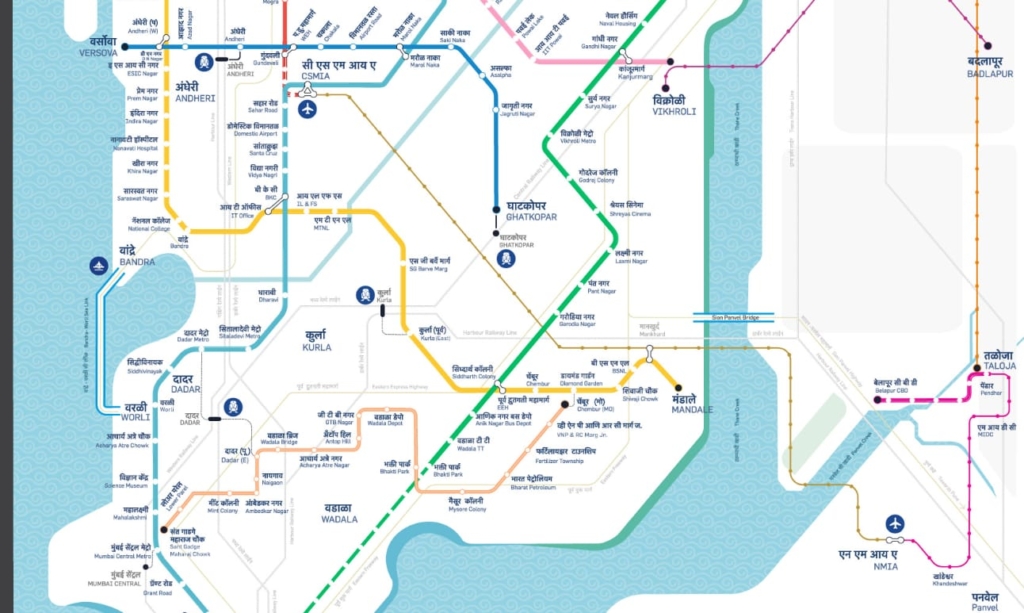
Mumbai Metro Line 8 runs in an east–south-east direction, starting in the western suburbs of Mumbai and ending in Ulwe, Navi Mumbai.
Starting Point
- CSMIA Terminal 2 (Andheri East)
- Fully underground station
- Direct integration with airport terminal
Mumbai Section (Underground + Elevated)
After leaving CSMIA, the line passes through dense urban zones, largely underground initially to minimize land acquisition and disruption.
Key Mumbai-side stations include:
- Marol Naka – Interchange with Metro Line 1 & Line 3
- Saki Naka – Commercial and residential hub
- Powai – Major IT, education, and corporate zone
- Kanjurmarg – Proposed interchange with Metro Line 6
- Mulund East – High-density residential area
Creek Crossing & Navi Mumbai Entry
- Elevated corridor crosses Vashi Creek, a major engineering milestone
- Enters Navi Mumbai along strategic transport corridors
Navi Mumbai Section
Once in Navi Mumbai, the line serves key nodes that are already witnessing rapid real estate and commercial growth.
Important stations include:
- Airoli – Business district and IT parks
- Ghansoli – Residential + commercial mix
- Koparkhairane – Well-established node
- Vashi – Central Navi Mumbai hub
- Nerul – Residential and educational zone
- CBD Belapur – Administrative and business center
- Seawoods – Major residential + mall district
- Ulwe – Airport influence zone
Ending Point
- Navi Mumbai International Airport (NMIA)
- Stations planned near Terminal 1 & Terminal 2
- Integrated with airport infrastructure
Total Stations (Indicative)
- Around 20 stations
- Mix of underground and elevated stations
- Multiple interchange points with other metro and rail lines
Interchanges & Network Integration
Metro Line 8 is not a standalone line—it is designed to integrate seamlessly with Mumbai’s wider transit network:
- Metro Line 1 (Versova–Ghatkopar)
- Metro Line 3 (Colaba–Bandra–SEEPZ)
- Metro Line 6 (Lokhandwala–Vikhroli)
- Navi Mumbai Metro Line 1
- Suburban Rail (Central Harbour Line)
This integration ensures last-mile connectivity and smooth transfers.
Travel Time & Passenger Experience
Expected Travel Time
- CSMIA to NMIA: ~30–45 minutes
- Powai to Vashi: ~25 minutes
Passenger Benefits
- Predictable travel time
- Luggage-friendly coaches (expected)
- Reduced dependence on taxis and private vehicles
- Stress-free airport transfers
Economic & Real Estate Impact
1. Boost to Property Values
Localities expected to benefit significantly:
- Ulwe
- Seawoods
- Belapur
- Ghansoli
- Powai
- Kanjurmarg
Residential and commercial prices around stations are expected to see long-term appreciation.
2. Commercial Growth
- Increased demand for offices near stations
- Growth in hotels, co-working spaces, and retail
- Better access to business districts across MMR
3. Job Creation
- Construction phase employment
- Long-term operations and maintenance jobs
- Indirect employment in retail, logistics, and services
Environmental Benefits
- Reduced road congestion
- Lower fuel consumption
- Decrease in carbon emissions
- Encouragement of public transport usage
Metro Line 8 aligns with Mumbai’s long-term sustainable mobility goals.
Project Challenges
Like any mega infrastructure project, Line 8 faces challenges:
- Underground tunneling in dense areas
- Creek crossing engineering complexity
- Inter-agency coordination (MMRDA, CIDCO, Airport Authorities)
- Funding and PPP structuring
However, these challenges are considered manageable with modern metro construction techniques.
Expected Timeline
| Phase | Status |
|---|---|
| DPR Approval | Completed |
| Detailed Design | Ongoing |
| Land & Utility Coordination | In progress |
| Construction Start | Expected soon |
| Phased Operations | 2028 onwards |
| Full Completion | 2029 (estimated) |
Final Thoughts: Why Metro Line 8 Is a Game Changer
Mumbai Metro Line 8 is more than just another metro corridor—it is a strategic infrastructure project that connects two global airports, integrates Mumbai and Navi Mumbai as a single economic region, and sets the foundation for future growth.
Once operational, it will:
- Transform airport connectivity
- Reduce travel stress for millions
- Unlock real estate and commercial potential
- Strengthen Mumbai’s position as a global city
Metro Line 8 is not just about movement—it’s about Mumbai’s future.
Frequently Asked Questions (FAQ) – Mumbai Metro Line 8 (Gold Line)
1. What is Mumbai Metro Line 8?
Mumbai Metro Line 8, also known as the Gold Line, is a proposed metro corridor that will connect Chhatrapati Shivaji Maharaj International Airport (CSMIA) in Mumbai with the Navi Mumbai International Airport (NMIA) in Ulwe. It is designed mainly for fast and seamless airport connectivity.
2. Why is Metro Line 8 important for Mumbai?
Metro Line 8 is important because Mumbai will soon have two international airports. This line will reduce road congestion, cut travel time between the airports, and provide a reliable, traffic-free public transport option for passengers, airport staff, and daily commuters.
3. What will be the total length of Mumbai Metro Line 8?
The total length of Mumbai Metro Line 8 is expected to be around 34–35 kilometers, consisting of both underground and elevated sections.
4. How many stations will Metro Line 8 have?
Mumbai Metro Line 8 is planned to have approximately 20 stations, including major interchange stations in Mumbai and Navi Mumbai, along with terminal stations at both airports.
5. Which major areas will Metro Line 8 connect?
Metro Line 8 will connect key locations such as Andheri (CSMIA), Marol, Powai, Kanjurmarg, Mulund, Airoli, Ghansoli, Vashi, Nerul, CBD Belapur, Seawoods, Ulwe, and finally Navi Mumbai International Airport (NMIA).
6. How much travel time will Metro Line 8 save?
Currently, road travel between CSMIA and NMIA can take 1.5 to 2 hours during peak traffic. Metro Line 8 is expected to reduce this to about 30–45 minutes, offering predictable and hassle-free travel.
7. Will Metro Line 8 connect with other metro lines?
Yes, Metro Line 8 will have multiple interchange points with existing and upcoming metro lines, including Metro Line 1, Line 3, Line 6, and Navi Mumbai Metro Line 1, as well as suburban railway stations.
8. When is Mumbai Metro Line 8 expected to be completed?
As per current plans, Metro Line 8 is expected to be completed in phases by 2028–2029, subject to approvals, funding, and construction progress.
9. How will Metro Line 8 impact real estate?
Metro Line 8 is expected to boost property demand and prices in areas like Ulwe, Seawoods, Belapur, Ghansoli, Powai, and Kanjurmarg due to improved connectivity, making these locations attractive for both homebuyers and investors.
10. Is Mumbai Metro Line 8 only for airport passengers?
No. While airport connectivity is the primary purpose, Metro Line 8 will also serve daily commuters, office-goers, students, and residents living along the corridor, making it a vital part of Mumbai’s overall public transport network.