 by Nayeghar
Are you looking to break into the property market this year? Whether you’re launching a boutique brokerage, a PropTech app, or a real estate investment firm, your success depends on one thing: the plan.
In a 2026 market defined by AI valuations, sustainable “Green-Point” ratings, and fractional ownership, a generic template won’t cut it. This guide breaks down exactly how to build a scalable real estate business plan that attracts investors and dominates the local market.
Why You Need a Business Plan (Beyond the Funding)
Most real estate start-ups fail within the first two years due to poor cash flow management and lack of niche focus. A structured business plan acts as your GPS, helping you:
- Identify Your Niche: Are you focusing on luxury flips, multi-family rentals, or AI-driven property management?
- Forecast Financials: Map out your “survival number” vs. your “dream number.”
- Mitigate Risks: Prepare for interest rate fluctuations and regulatory changes (like the 2026 Green Building Mandates).
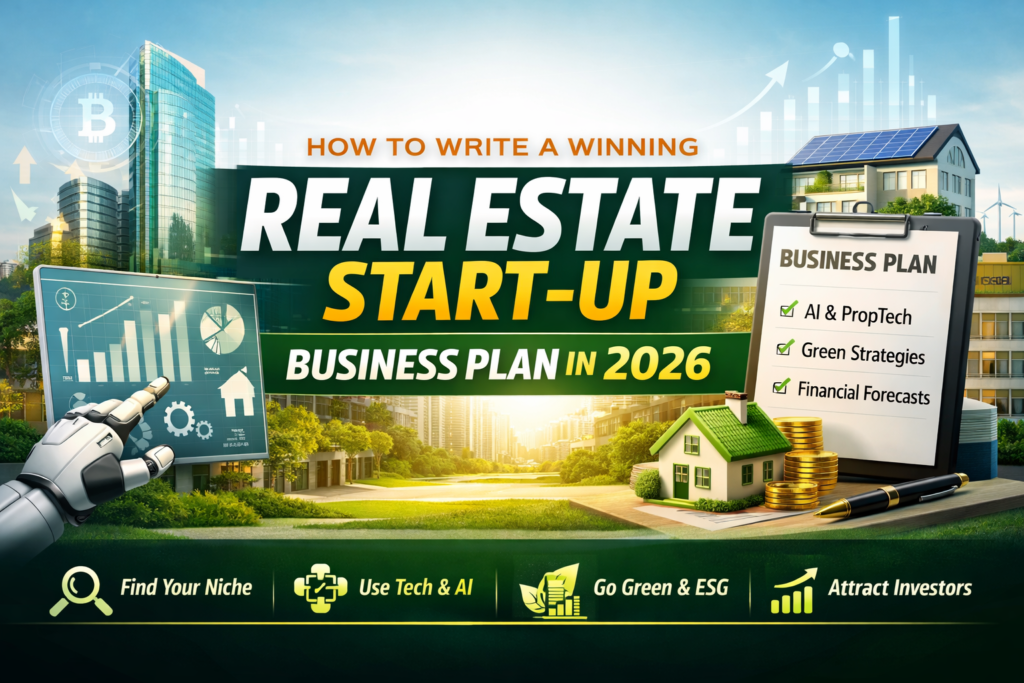
1. The Executive Summary: Your 60-Second Pitch
This is the most important section. Investors often read only this part before deciding to go further.
- Mission Statement: Define your “Why.” (e.g., “To make homeownership accessible through blockchain-verified fractional equity.”)
- The Problem: What is broken in your local market? (High entry costs, lack of transparency, etc.)
- Your Solution: How does your start-up fix it?
2. Market Analysis & The 2026 Competitive Edge
You cannot sell to “everyone.” To rank locally and perform well, you need to understand the Data of the Now.
- SWOT Analysis: * Strengths: Deep local networking, tech-savviness.
- Weaknesses: Limited capital, new brand identity.
- Opportunities: New rezoning laws in suburban hubs.
- Threats: Rising inventory costs or institutional buyers.
- Target Demographics: In 2026, focus on “Digital Nomads,” “Eco-Conscious Gen Z Buyers,” or “Downsizing Boomers.”
3. Operations: Integrating AI and PropTech
Modern real estate isn’t just about handshakes; it’s about systems. Your plan should detail your “Tech Stack”:
- CRM & Automation: Using AI to nurture leads while you sleep.
- Virtual Tours: Using AR/VR for remote showings—a standard expectation in 2026.
- Smart Contracts: How you’ll use blockchain to speed up the “Contract-to-Close” period.
4. The Marketing Strategy: Beyond the Yard Sign
How will people find you? An SEO-driven marketing plan is non-negotiable.
- Lead Pillars: Choose 3 core sources (e.g., Google Search, Local Community Events, and LinkedIn Networking).
- Content Strategy: Detail how you will use “People-First” content—blogs, market reports, and video tours—to build EEAT (Experience, Expertise, Authoritativeness, and Trustworthiness).
- SEO Keywords for 2026: Focus on long-tail keywords like “Best eco-friendly condos in [Your City]” or “How to buy fractional real estate in 2026.”
5. Financial Projections & Funding
Investors want to see the math. Provide a 3-year outlook including:
- Startup Costs: Licensing, MLS fees, branding, and initial ad spend.
- Unit Economics: What is your Customer Acquisition Cost (CAC) vs. the Lifetime Value (LTV) of a client?
- The Break-Even Point: Exactly when will the business become profitable?
Pro Tip: In 2026, institutional lenders are prioritizing “Green” startups. If your business model includes sustainability (ESG), highlight this to secure lower interest rates.
Conclusion: Build to Evolve
A real estate business plan is a living document. In a fast-paced 2026 economy, the most successful start-ups are those that review their KPIs monthly and pivot when the data speaks.
Ready to launch? Download our 2026 Real Estate Business Plan Template [Link] to get started today.