 by Nayeghar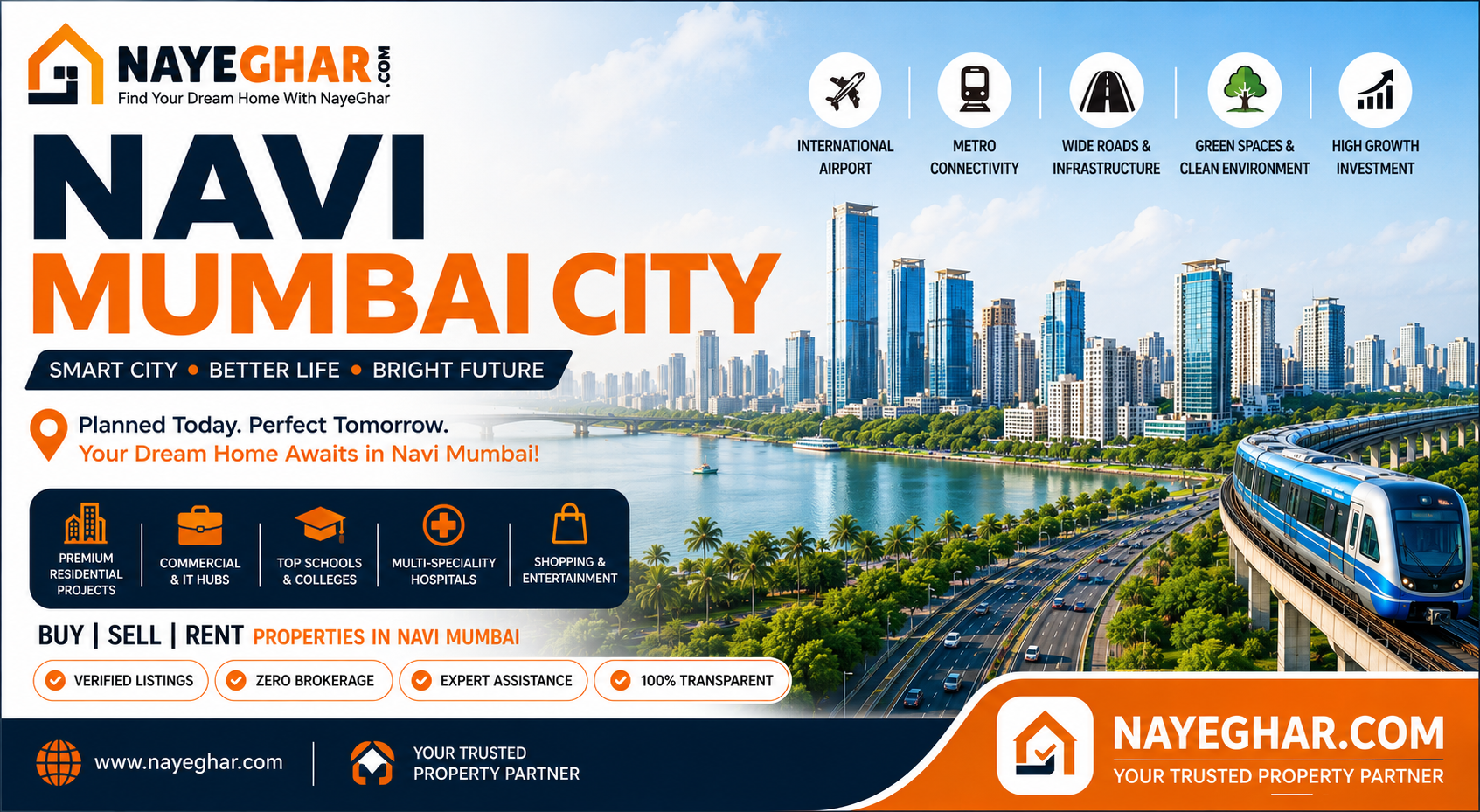
Navi Mumbai City – India’s Smart Planned City
Navi Mumbai is one of India’s most successful planned cities and has emerged as Maharashtra’s fastest-growing business, residential, and infrastructure hub. Developed by CIDCO (City and Industrial Development Corporation), the city was designed to reduce the population pressure on Mumbai while providing world-class urban infrastructure.
Today, Navi Mumbai is known for its modern road network, excellent railway connectivity, upcoming international airport, metro connectivity, IT parks, educational institutions, hospitals, shopping malls, and premium residential projects. With continuous government investment in mega infrastructure projects, Navi Mumbai has become one of the most attractive real estate destinations in India.
Table of Contents
- About Navi Mumbai
- History of Navi Mumbai
- Why Navi Mumbai Was Developed
- CIDCO and City Planning
- Navi Mumbai Map
- Major Nodes of Navi Mumbai
- Infrastructure Development
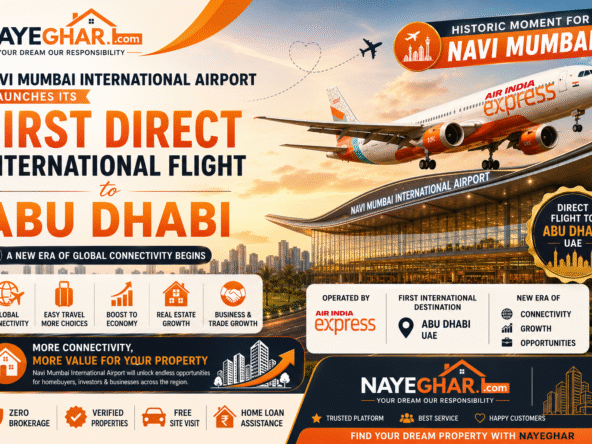
- Navi Mumbai International Airport
- Mumbai Trans Harbour Link (Atal Setu)
- Navi Mumbai Metro
- Railway Connectivity
- Road Connectivity
- Upcoming Infrastructure Projects
- Commercial Hubs
- IT Parks
- Education
- Healthcare
- Shopping & Entertainment
- Tourist Attractions
- Real Estate Market
- Property Prices
- Best Areas to Buy Property
- Future Growth
- Investment Opportunities
- Advantages of Living
- Challenges
- Why Invest in Navi Mumbai?
- Why Choose NayeGhar?
- FAQs
About Navi Mumbai
Navi Mumbai is a planned satellite city located on the eastern side of Mumbai across Thane Creek. Spread over more than 340 square kilometres, it consists of multiple well-planned residential and commercial nodes connected through wide roads, railway lines, highways, and metro corridors.
Unlike old Mumbai, Navi Mumbai offers:
- Wide roads
- Better traffic management
- Large open spaces
- Planned residential sectors
- Modern infrastructure
- Better quality of life
Today, Navi Mumbai is considered one of India’s smartest urban developments.
History of Navi Mumbai
During the 1960s, Mumbai experienced rapid population growth, resulting in overcrowding, traffic congestion, and housing shortages.
To address these issues, the Government of Maharashtra established CIDCO in 1970.
The vision was to create a modern twin city that could absorb future population growth while providing:
- Planned housing
- Employment
- Commercial districts
- Transportation
- Public amenities
Construction began in the early 1970s, and today Navi Mumbai is home to millions of residents.
Why Navi Mumbai Was Developed
The city was developed to:
- Reduce pressure on Mumbai
- Provide affordable housing
- Create new employment centres
- Improve transportation
- Encourage balanced regional development
- Build modern infrastructure
CIDCO – The Master Planner
CIDCO has played a significant role in transforming Navi Mumbai into one of India’s best-planned cities.
CIDCO has developed:
- Residential sectors
- Commercial complexes
- Metro network
- International Airport
- Golf Course
- Central Park
- Corporate Parks
- Roads
- Bridges
Navi Mumbai City Map
Major areas include:
- Vashi
- Sanpada
- Juinagar
- Nerul
- Seawoods
- CBD Belapur
- Kharghar
- Taloja
- Kamothe
- Kalamboli
- Panvel
- Ulwe
- Dronagiri
- Pushpak Nagar
- Karanjade
Each node has its own commercial centres, schools, hospitals, shopping malls, and residential projects.
Major Residential Nodes
Vashi
Known as the commercial gateway of Navi Mumbai with premium residential apartments and business centres.
Nerul
One of the most developed locations featuring Palm Beach Road, schools, hospitals, and luxury housing.
Seawoods
Home to Nexus Seawoods Mall and premium residential developments.
CBD Belapur
The administrative and business centre housing government offices and corporate headquarters.
Kharghar
Known for Central Park, golf course, educational institutions, and premium residential projects.
Taloja
An emerging affordable housing destination with metro connectivity and strong appreciation potential.
Panvel
Rapidly developing due to the Navi Mumbai International Airport and major infrastructure projects.
Infrastructure Development
Navi Mumbai boasts one of India’s strongest infrastructure networks.
Major projects include:
- Navi Mumbai International Airport
- Atal Setu
- Metro Rail
- Palm Beach Road
- Coastal Road
- Nerul-Uran Rail Corridor
- Multi-Modal Transport Hub
- International Corporate Park (BKC 2)
- Kharghar-Turbhe Tunnel
Navi Mumbai International Airport
The upcoming airport is expected to transform the entire real estate market.
Benefits include:
- International connectivity
- Employment generation
- Higher property appreciation
- Logistics hub
- Tourism growth
- Commercial expansion
Nearby investment locations include:
- Ulwe
- Pushpak Nagar
- Dronagiri
- Panvel
- Kharghar
- Taloja
Atal Setu (Mumbai Trans Harbour Link)
India’s longest sea bridge connects Sewri (Mumbai) with Chirle (Navi Mumbai).
Benefits:
- Faster travel to Mumbai
- Improved logistics
- Better connectivity
- Increase in property values
Navi Mumbai Metro
Metro corridors connect:
- CBD Belapur
- Pendhar
- Taloja
- Kharghar
Future phases will improve connectivity across the city.
Railway Connectivity
Navi Mumbai is connected through:
- Harbour Line
- Trans Harbour Line
- Central Railway
- Nerul-Uran Line
Major stations include:
- Vashi
- Nerul
- Belapur
- Seawoods
- Kharghar
- Panvel
Road Connectivity
Major roads include:
- Palm Beach Road
- Sion-Panvel Highway
- Mumbai-Pune Expressway
- NH-48
- Atal Setu
- JNPT Road
Upcoming Mega Projects
- Navi Mumbai International Airport
- International Corporate Park (BKC 2)
- Metro Expansion
- Kharghar-Turbhe Tunnel
- Coastal Road
- Smart City Initiatives
- Data Centres
- Logistics Parks
Commercial & IT Hubs
Major employment centres include:
- Millennium Business Park
- Airoli IT Park
- Mindspace Airoli
- CBD Belapur Business District
- International Corporate Park (BKC 2)
- Mahape IT Park
- TTC Industrial Area
These hubs attract professionals from across India.
Education
Top educational institutions include:
- NMIMS Navi Mumbai
- DY Patil University
- Bharati Vidyapeeth
- Ryan International School
- Apeejay School
- DAV Public School
Healthcare
Leading hospitals:
- Apollo Hospital
- MGM Hospital
- DY Patil Hospital
- Fortis Hiranandani Hospital
- Reliance Hospital
Shopping & Entertainment
Popular destinations:
- Nexus Seawoods Mall
- Inorbit Mall Vashi
- Little World Mall
- Raghuleela Mall
- Central Park
- Wonders Park
Tourist Attractions
- Central Park
- Pandavkada Waterfalls
- Belapur Fort
- Kharghar Hills
- Flamingo Point
- Jewel of Navi Mumbai
- Karnala Bird Sanctuary
Real Estate Market
Navi Mumbai offers:
- 1 RK Apartments
- 1 BHK
- 2 BHK
- 3 BHK
- Luxury Apartments
- Villas
- Plots
- Commercial Offices
- Retail Shops
Best Locations for Property Investment
Kharghar
Ideal for premium residential buyers.
Taloja
Best affordable investment destination.
Panvel
Airport-driven appreciation.
Ulwe
Strong future growth due to airport and Atal Setu.
Dronagiri
Emerging investment hotspot.
Kamothe
Excellent connectivity and social infrastructure.
Why Property Prices Are Rising
Major reasons include:
- Airport development
- Metro expansion
- Atal Setu
- BKC 2
- Corporate offices
- IT parks
- Government investment
- Increasing employment
Advantages of Living in Navi Mumbai
- Planned city
- Better air quality
- Lower traffic than Mumbai
- Modern infrastructure
- Affordable housing options
- Good schools and hospitals
- Excellent connectivity
- Green open spaces
- Strong investment potential
- Better quality of life
Challenges
- Ongoing construction in some developing areas
- Traffic congestion during peak hours in select corridors
- Higher prices in established nodes
- Flooding concerns in isolated low-lying areas during extreme monsoon events
Why Invest in Navi Mumbai in 2026?
Navi Mumbai is witnessing one of India’s largest infrastructure transformations. The combination of the international airport, metro network, Atal Setu, corporate parks, logistics hubs, and expanding residential communities makes it a compelling destination for both homebuyers and long-term investors. As connectivity improves and employment opportunities grow, demand for residential and commercial properties is expected to remain strong.
Whether you’re a first-time buyer, an investor, or looking for a luxury home, Navi Mumbai offers options across a wide range of budgets.
Why Choose NayeGhar?
NayeGhar helps simplify your property search by offering:
- Verified property listings
- New projects from reputed developers
- Resale and rental properties
- Expert property consultation
- Home loan assistance
- Site visit support
- RERA project guidance
- Transparent buying process
- End-to-end customer assistance
Conclusion
Navi Mumbai has evolved from a planned satellite township into one of India’s most dynamic urban centres. With modern infrastructure, expanding business districts, improved transportation, and a robust real estate market, it continues to attract families, professionals, and investors. As major infrastructure projects reach completion, the city is well-positioned for sustained growth in the years ahead, making it an excellent place to live, work, and invest.
Frequently Asked Questions (FAQs)
Is Navi Mumbai a good place to live?
Yes. It offers planned infrastructure, good connectivity, quality schools, hospitals, and a higher quality of life than many densely populated urban areas.
Which is the best area to invest in Navi Mumbai?
Kharghar, Panvel, Ulwe, Taloja, Kamothe, and Dronagiri are among the most sought-after investment destinations.
Is Navi Mumbai International Airport operational?
The airport is under phased development and is expected to significantly boost connectivity and the surrounding real estate market.
Is Navi Mumbai better than Mumbai?
For many homebuyers, Navi Mumbai provides more space, better planning, less congestion, and comparatively affordable housing, while Mumbai remains the primary financial and commercial centre.
Is investing in Navi Mumbai safe?
Investing in RERA-registered projects from reputed developers and conducting proper legal due diligence can make property investment in Navi Mumbai a sound long-term choice.
Which industries are driving growth in Navi Mumbai?
IT, logistics, warehousing, financial services, manufacturing, ports, and commercial real estate are key growth sectors supporting the city’s expansion.