 by Nayeghar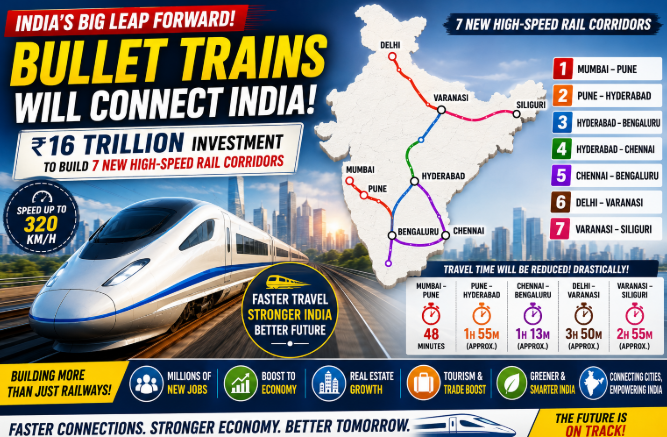
7 New High-Speed Rail Corridors Could Transform India’s Future Transportation System
India is preparing for one of the biggest transportation revolutions in its history. The central government is planning to develop seven new high-speed rail corridors across the country with an estimated investment of nearly ₹16 trillion ($190+ billion). This ambitious project aims to create a modern bullet train network that could completely change the way Indians travel, work, and connect with major cities.
After the success and rapid progress of the Mumbai–Ahmedabad Bullet Train Project, the government is now focusing on expanding high-speed rail connectivity to multiple regions of the country. These projects are expected to reduce travel time drastically, improve economic growth, create millions of jobs, and strengthen India’s infrastructure for the future.
The proposed high-speed rail corridors will connect some of India’s largest economic and cultural hubs, making long-distance travel faster, more comfortable, and more efficient.
India’s Vision for High-Speed Rail
India has been rapidly modernizing its railway infrastructure over the last few years. From Vande Bharat trains to dedicated freight corridors, Indian Railways is entering a new era of modernization.
The government now wants to take this transformation to the next level by building a nationwide bullet train ecosystem similar to countries like Japan, China, and France.
The main objective of these new bullet train projects is to:
- Reduce travel time between major cities
- Improve business connectivity
- Support economic development
- Boost tourism
- Create smart urban growth corridors
- Strengthen transportation infrastructure
- Generate employment opportunities
According to reports, feasibility studies and viability assessments for these new routes are already underway.
List of Proposed Bullet Train Corridors
The government is planning seven major high-speed rail corridors across India.
1. Mumbai – Pune High-Speed Rail Corridor
The Mumbai–Pune route is one of the busiest travel corridors in India. Thousands of people travel daily between these two cities for business, education, and work.
The bullet train could reduce travel time from nearly 3–4 hours to less than 50 minutes.
Expected Benefits:
- Faster business travel
- Better connectivity between Maharashtra’s major cities
- Growth in real estate and IT sectors
- Reduced traffic on expressways
2. Pune – Hyderabad High-Speed Rail Corridor
This corridor would connect Maharashtra with Telangana and significantly improve South India’s economic connectivity.
The travel time between Pune and Hyderabad could reduce from nearly 9 hours to under 2 hours.
Key Advantages:
- Better IT and startup ecosystem connectivity
- Growth in industrial investments
- Easier interstate travel
3. Hyderabad – Bengaluru High-Speed Rail Corridor
Hyderabad and Bengaluru are among India’s largest technology hubs. A high-speed rail link between these cities would support business expansion and improve mobility for professionals.
Major Impact:
- Boost to India’s tech industry
- Improved corporate travel
- Faster movement of skilled workforce
4. Hyderabad – Chennai Bullet Train Corridor
This route would connect two important southern metro cities and improve trade, logistics, and tourism.
Benefits:
- Enhanced industrial connectivity
- Better tourism opportunities
- Faster passenger movement
5. Chennai – Bengaluru High-Speed Rail Corridor
This is expected to become one of India’s busiest bullet train routes because of heavy passenger demand between the two cities.
The route will support:
- IT sector growth
- Manufacturing industries
- Startup ecosystem
- Real estate development
Travel time could reduce to nearly one hour.
6. Delhi – Varanasi High-Speed Rail Corridor
This proposed route is considered strategically important because it connects the national capital with eastern Uttar Pradesh.
The corridor may become a major driver of development across North India.
Potential Benefits:
- Religious tourism growth
- Better regional connectivity
- Faster access to business centers
- Development of tier-2 cities
Travel time between Delhi and Varanasi could reduce to under 4 hours.
7. Varanasi – Siliguri High-Speed Rail Corridor
This route could significantly improve connectivity in eastern and northeastern India.
The project is expected to:
- Improve transportation infrastructure
- Increase tourism
- Support trade movement
- Encourage regional development
This corridor could become a game changer for eastern India.
Investment Worth ₹16 Trillion
The estimated investment for these seven high-speed rail corridors is around ₹16 trillion, making it one of India’s largest infrastructure projects ever.
This investment will include:
- Railway track construction
- Station development
- Land acquisition
- Technology systems
- Signaling infrastructure
- Safety systems
- Train manufacturing
- Bridges and tunnels
The government is expected to use a combination of:
- Public funding
- International partnerships
- Long-term infrastructure financing
- Foreign technology collaboration
Japan is already supporting India’s Mumbai–Ahmedabad bullet train project through financial and technical assistance.
How Fast Will These Bullet Trains Run?
India’s upcoming bullet trains are expected to operate at speeds of up to 320 km/h.
This would place India among the countries with advanced high-speed rail systems.
Estimated Travel Time Reductions
| Route | Current Time | Expected Bullet Train Time |
|---|---|---|
| Mumbai – Pune | 3–4 Hours | 48 Minutes |
| Pune – Hyderabad | 8–9 Hours | Under 2 Hours |
| Chennai – Bengaluru | 6 Hours | Around 1 Hour |
| Delhi – Varanasi | 10–12 Hours | Under 4 Hours |
These travel time reductions could completely transform domestic transportation.
Impact on India’s Economy
The economic impact of the bullet train network could be enormous.
Large-scale infrastructure projects often create long-term economic growth by improving productivity, mobility, and investment opportunities.
Major Economic Benefits
1. Job Creation
Millions of direct and indirect jobs may be generated through:
- Construction work
- Engineering
- Manufacturing
- Technology services
- Operations and maintenance
2. Growth in Real Estate Sector
Areas near bullet train stations could witness significant increases in property demand and prices.
Cities connected through high-speed rail often experience:
- New housing projects
- Commercial development
- Smart city expansion
- Increased land value
For real estate platforms and investors, this could create massive opportunities.
3. Industrial Growth
The project will require:
- Steel
- Cement
- Electrical systems
- Machinery
- Construction materials
This could boost manufacturing and industrial production across India.
4. Tourism Expansion
Faster connectivity will encourage domestic tourism.
Religious destinations like Varanasi and major metro cities could see:
- Higher tourist arrivals
- Better hospitality business growth
- Increased travel spending
Technology and “Make in India” Push
India is also focusing on developing local capabilities for high-speed rail technology.
The government wants future bullet train systems to support the “Make in India” initiative by:
- Manufacturing components domestically
- Developing local expertise
- Reducing dependence on imports
- Creating advanced engineering capabilities
This could help India emerge as a global railway manufacturing hub in the future.
Challenges Facing the Project
Despite its massive potential, the bullet train expansion project also faces several challenges.
1. Land Acquisition
Acquiring land for railway corridors can be difficult and time-consuming.
2. High Construction Cost
Bullet train infrastructure is extremely expensive due to:
- Elevated tracks
- Tunnels
- Advanced safety systems
- Specialized technology
3. Environmental Approvals
Large infrastructure projects require multiple environmental and regulatory clearances.
4. Long Project Timelines
Such projects usually take several years to complete.
Delays in approvals or construction can increase costs significantly.
Mumbai–Ahmedabad Bullet Train: India’s First Step
India’s first bullet train project between Mumbai and Ahmedabad is currently under construction and is expected to become the foundation for future high-speed rail expansion.
The project includes:
- Advanced Japanese Shinkansen technology
- Modern safety systems
- Elevated rail infrastructure
- High-speed stations
Its success will likely influence the speed and scale of future bullet train projects in India.
Future of Transportation in India
India’s transportation landscape is rapidly changing.
With:
- Vande Bharat trains
- Expressways
- Metro rail systems
- Dedicated freight corridors
- Bullet train projects
the country is moving toward a highly connected future.
The proposed bullet train network could become one of the biggest symbols of modern India’s infrastructure transformation.
Conclusion
The proposed ₹16 trillion investment in seven new high-speed rail corridors could mark the beginning of a new transportation era in India.
If completed successfully, these projects will:
- Revolutionize travel
- Reduce journey times
- Boost the economy
- Support real estate growth
- Generate employment
- Strengthen regional development
India is now preparing to join the league of nations with world-class high-speed rail infrastructure, and the coming decade may completely redefine how people travel across the country.
For millions of Indians, the dream of fast, modern, and efficient bullet train travel is slowly becoming a reality.