 by Nayeghar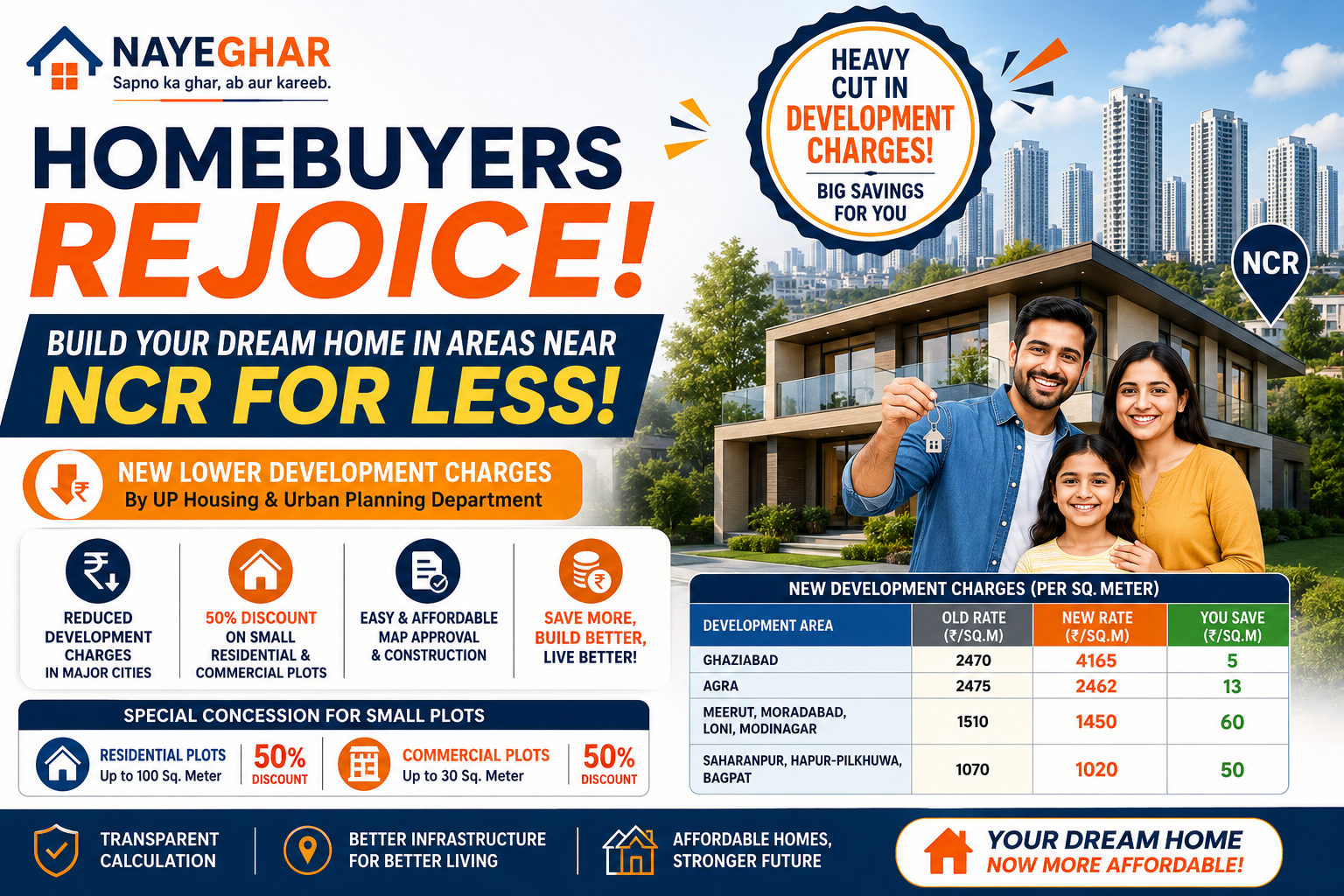
The real estate market in Uttar Pradesh has received a major boost as the Uttar Pradesh Housing and Urban Planning Department announced revised and reduced development charges across several cities near the National Capital Region (NCR). The decision is expected to benefit homebuyers, small investors, builders, and commercial property owners by reducing the overall cost of property development and map approvals.
Cities such as Ghaziabad, Meerut, Moradabad, Agra, Mathura, Saharanpur, Hapur, and Bagpat will now see lower development fees, making housing projects and individual home construction more affordable.
This move is especially significant at a time when rising construction costs and expensive approvals have become a challenge for middle-class homebuyers and real estate developers.
What Are Development Charges?
Development charges are fees collected by local development authorities such as:
- Ghaziabad Development Authority (GDA)
- Meerut Development Authority (MDA)
- Development authorities in different cities across Uttar Pradesh
These charges are paid when:
- Constructing a new house
- Approving a building layout
- Developing residential or commercial projects
- Reconstructing old buildings
- Changing land use from agricultural to residential or commercial
The collected funds are generally used for:
- Road development
- Drainage systems
- Public infrastructure
- Green belts and parks
- Urban planning projects
- Water and sewage systems
In simple terms, development charges help authorities improve civic infrastructure in growing urban regions.
Revised Development Charges in NCR and Nearby Cities
The UP Housing and Urban Planning Department has officially reduced development charges in multiple development zones.
New Development Charges (Per Square Meter)
| Development Area | Old Rate (₹/sqm) | New Rate (₹/sqm) |
|---|---|---|
| Ghaziabad | 4170 | 4165 |
| Agra | 2475 | 2462 |
| Meerut, Moradabad, Loni, Modinagar | 1510 | 1450 |
| Saharanpur, Hapur-Pilkhuwa, Bagpat | 1070 | 1020 |
While the reduction may appear small on paper, the impact becomes substantial when calculated on larger plots, housing societies, or commercial projects.
50% Discount for Small Residential and Commercial Plots
One of the most important highlights of the new policy is the special concession for smaller plots.
The government has announced:
- 50% reduction in development charges for residential plots up to 100 square meters
- 50% reduction for commercial plots up to 30 square meters
Discount Structure
| Plot Category | Maximum Plot Size | Applicable Development Charge |
|---|---|---|
| Residential Plot | Up to 100 sqm | Only 50% of total charge |
| Commercial Plot | Up to 30 sqm | Only 50% of total charge |
This decision directly benefits:
- Middle-class families
- First-time homebuyers
- Small shop owners
- Local builders
- Affordable housing developers
Why This Decision Matters for Homebuyers
The reduction in development charges can significantly lower the total cost of building a home.
For example:
Imagine a person owns a 100 square meter residential plot.
If the earlier development charge was ₹4,000 per square meter:
- Total fee = ₹4 lakh
If the revised charge becomes ₹2,000 per square meter:
- Total fee = ₹2 lakh
This creates direct savings of ₹2 lakh for the property owner.
For middle-income buyers, such savings can:
- Reduce home loan burden
- Lower construction expenses
- Improve affordability
- Encourage legal map approvals
- Boost planned urban development
Positive Impact on NCR Real Estate Market
The decision is likely to positively influence the real estate market in NCR-adjacent regions.
1. Affordable Housing Will Get a Boost
Cities around Delhi NCR are already attracting buyers because property prices are relatively lower compared to Delhi and Gurgaon. Reduced development charges will make these markets even more attractive.
Areas like:
- Ghaziabad
- Meerut
- Modinagar
- Hapur
- Loni
could see increased demand from homebuyers searching for affordable homes near Delhi.
2. Builders May Launch More Projects
Lower approval and development costs improve project feasibility for developers. Builders may now focus more on:
- Budget housing
- Mid-income apartments
- Small commercial spaces
- Integrated townships
This could also generate more employment opportunities in construction and allied industries.
3. Faster Urban Expansion
The revised policy can encourage organized urban growth in Tier-2 and Tier-3 cities of Uttar Pradesh.
With better affordability and infrastructure planning, cities like:
- Saharanpur
- Moradabad
- Agra
- Mathura-Vrindavan
may witness higher real estate activity in the coming years.
Transparent Formula for Development Charge Calculation
The government has also emphasized a more transparent calculation system for development charges.
The revised formula considers:
- Plot size
- Land usage type
- Number of flats or population density
- Project location
This means charges will now be more logical and better aligned with the actual impact of a project on city infrastructure.
What Happens If You Buy a Home in an Already Developed Colony?
Many buyers often worry whether they will have to pay development charges separately after purchasing a flat or house in a developed society.
The answer is generally no.
In most cases:
- The builder or colonizer already pays development charges to the authority during project approval.
- End buyers are not required to pay these charges again separately.
However, buyers should always verify project approvals before purchasing property.
Does Agricultural Land Attract Development Charges?
If land is being used strictly for agricultural purposes, development charges are usually not applicable.
But if:
- agricultural land is converted into residential use
- commercial construction is planned
- land use changes officially
then development charges become applicable as per authority regulations.
A Big Relief for Middle-Class Families
The UP government’s decision comes as a major relief for families planning to build their dream home.
At a time when:
- cement prices are rising
- labor costs are increasing
- construction materials are expensive
- property prices continue to climb
even a moderate reduction in government fees can create meaningful financial relief.
The 50% concession for smaller plots is particularly beneficial for:
- salaried families
- self-employed buyers
- first-time homeowners
- small entrepreneurs
Future Outlook for NCR Real Estate
Experts believe the reduction in development charges may:
- increase housing demand
- improve property registrations
- encourage legal constructions
- reduce unauthorized colonies
- strengthen planned urbanization
NCR-adjacent cities in Uttar Pradesh are already gaining popularity due to:
- better connectivity
- expressways
- metro expansion
- industrial corridors
- affordable property prices
With lower government charges, these regions may emerge as stronger investment destinations over the next few years.
Final Thoughts
The Uttar Pradesh government’s revised development charge policy is a positive step toward making housing more affordable and encouraging organized urban development.
For homebuyers, especially in NCR-connected regions, this means:
- lower construction costs
- reduced approval expenses
- better affordability
- easier access to legal housing
Whether you are planning to build your dream home, invest in property, or start a small commercial setup, the new development charge structure can help reduce overall project expenses significantly.
As infrastructure continues to improve across NCR and nearby UP cities, this policy may further accelerate growth in the region’s real estate market.