 by Nayeghar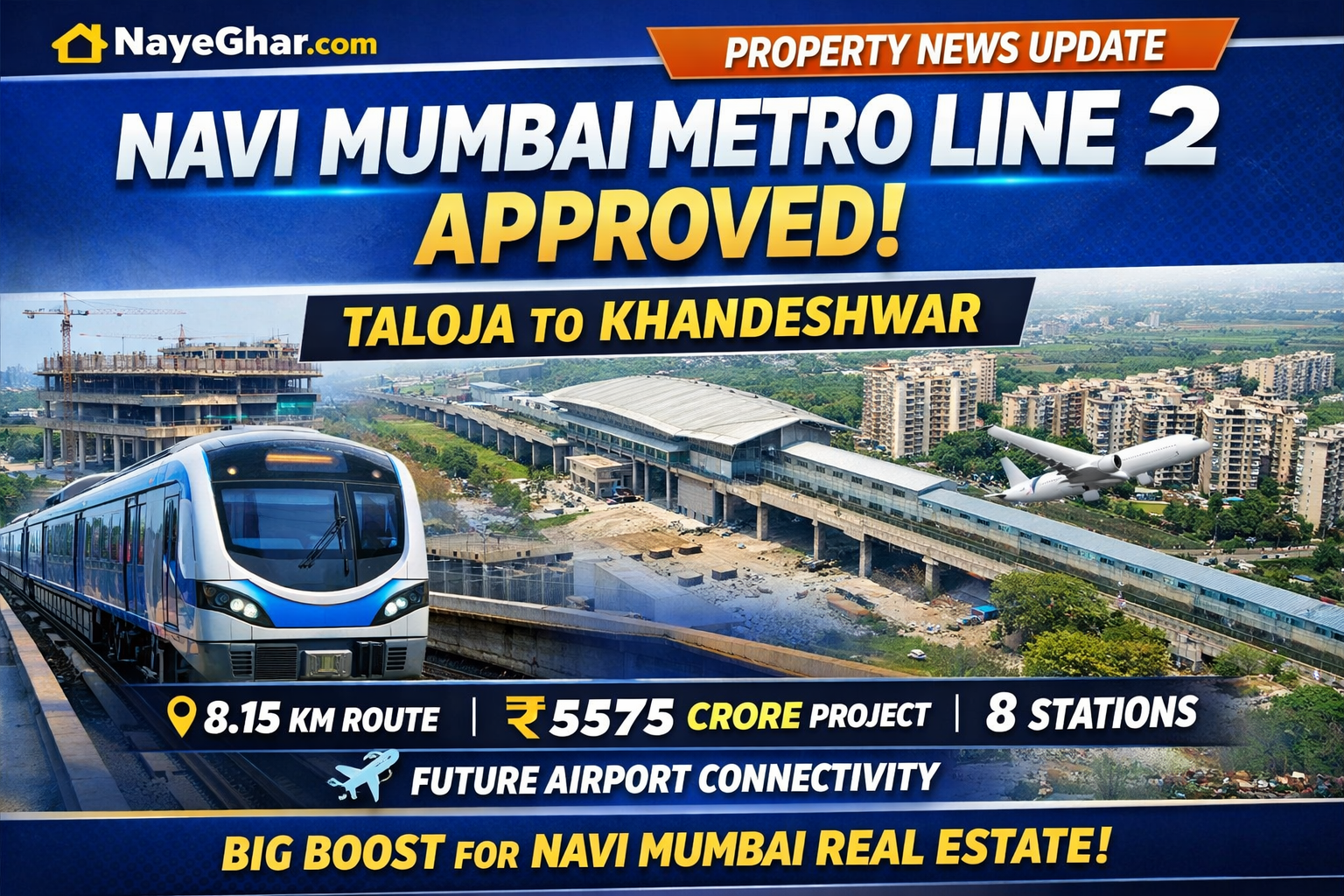
Navi Mumbai is set to take another major step in its urban transport journey. After being proposed nearly 15 years ago, Navi Mumbai Metro Line 2 has now received state approval, bringing new momentum to one of the city’s long-pending infrastructure plans. The new metro corridor will run from Taloja to Khandeshwar, cover 8.15 km, cost around ₹5,575 crore, and include eight stations across key developing nodes of Navi Mumbai. Reports also indicate that the line could eventually help improve connectivity to the upcoming Navi Mumbai International Airport, making it even more significant for commuters, businesses, and the real estate market.
For residents of areas such as Taloja, Kalamboli, and Kamothe, this is more than just another government announcement. It is a major public transport proposal that could reshape daily travel, reduce dependence on road-based commuting, and support the next phase of Navi Mumbai’s growth. The approval is also important because it revives a corridor that had remained on paper for years despite rising development across the region.
A Long-Pending Project Finally Moves Forward
The Taloja–Khandeshwar corridor is not a new idea. It was first proposed by CIDCO around 15 years ago, but for a long time the project did not see the progress many had expected. The recent state nod changes that narrative. With budgetary backing of ₹5,575 crore, the metro line has now moved from an old proposal to an approved infrastructure project with clear public attention and renewed relevance.
This delay also highlights how infrastructure planning in fast-growing urban regions often moves slower than demand. During the years the project remained pending, Taloja, Kalamboli, and Kamothe continued to grow as residential and mixed-use zones. Today, the need for better rapid transit in these nodes is far stronger than it was when the line was first conceived. That makes the present approval especially meaningful.
Route Details: Taloja to Khandeshwar
According to recent reports, Navi Mumbai Metro Line 2 will connect Taloja and Khandeshwar through a corridor of 8.15 kilometres. The line is expected to pass through several key urban sectors that are already important in the city’s residential and transport map. It is designed to strengthen east-west and internal connectivity across growing nodes while also supporting integration with the wider metro and rail network in the future.
The project is expected to include eight stations. Reported station names include:
- Khandeshwar
- Sector 10 Kamothe
- Sector 2E Kalamboli
- Sector 7E Kalamboli
- Sector 13 Kalamboli
- Kasadi
- plus additional stations along the Taloja side of the route, as covered in recent reporting.
Some coverage has described the corridor as serving major neighbourhoods such as Kamothe, Kalamboli, and Taloja, all of which are seeing continued urban expansion and rising commuter movement.
Why This Corridor Matters
The approval of Metro Line 2 matters because Navi Mumbai is at a stage where transport infrastructure will directly shape its next decade of development. Roads in several parts of the region already face congestion during peak hours, and many commuters still depend heavily on private vehicles, buses, autos, and suburban rail links that do not always provide seamless last-mile access. A metro corridor through Taloja, Kalamboli, and Kamothe can address this gap by offering a faster and more predictable mode of travel.
The line is also important because Khandeshwar is a strategic node. Better connectivity to Khandeshwar can improve movement toward the suburban rail network and strengthen intermodal travel options for passengers coming from developing residential sectors further inland. Over time, this kind of integration can make Navi Mumbai more commuter-friendly and more attractive for planned urban expansion.
Impact on Taloja, Kalamboli, and Kamothe
Taloja
Taloja has emerged as one of the most talked-about locations in Navi Mumbai for affordable and mid-segment housing. However, one of its biggest challenges has been connectivity perception. Even when projects are attractively priced, many buyers hesitate if travel seems difficult or time-consuming. A metro line originating from or passing through Taloja can improve confidence among homebuyers and investors by making the area feel more integrated with the city’s transport map.
Kalamboli
Kalamboli is already an important node because of its road connectivity and growing residential base. The inclusion of multiple stations such as Sector 2E, Sector 7E, and Sector 13 suggests that the area could become one of the biggest beneficiaries of the new corridor. Better transit access within Kalamboli can reduce internal travel friction and improve access for residents, students, workers, and local businesses.
Kamothe
Kamothe has long been considered a strong residential location due to its planned layout and proximity to important transport routes. A station at Sector 10 Kamothe can further improve its urban value and daily commuting appeal. As infrastructure deepens in Kamothe, the area may see stronger interest from both end-users and investors who prefer locations with multiple transport options.
Potential Future Link to Navi Mumbai International Airport
One of the most exciting aspects of the project is the possibility that the line may eventually connect with the Navi Mumbai International Airport. Recent reports note that the corridor is expected to support future airport connectivity, which could dramatically improve its long-term strategic value.
Airport-linked metro routes often do much more than move air passengers. They influence business travel, hospitality growth, warehousing activity, office development, and residential demand in surrounding zones. Even the possibility of such future integration can raise the profile of areas located along or near the corridor. In Navi Mumbai’s case, where the airport itself is expected to be a major catalyst for regional development, metro connectivity can multiply that effect.
Cost Escalation Reflects the Scale of Delay
A notable aspect of the story is the steep increase in project cost. Recent coverage says the line was originally expected to cost far less, but the estimate has now risen to ₹5,575 crore. That change reflects the long delay, inflation in construction costs, and the larger financial burden of implementing transport infrastructure after years of postponement.
This is a common pattern in urban infrastructure. When projects are delayed, the eventual cost is often much higher than the original estimate. In that sense, the state approval not only revives the project but also underlines the importance of timely execution going forward.
What It Means for the Real Estate Market
From a real estate perspective, Metro Line 2 could become one of the most influential development triggers in this part of Navi Mumbai. Metro corridors typically improve the attractiveness of surrounding neighbourhoods in several ways: they reduce perceived distance, support better livability, improve access to jobs and services, and create stronger confidence among homebuyers. In cities like Mumbai and Navi Mumbai, transport-led growth is often one of the biggest drivers of price appreciation and project demand.
For locations like Taloja, metro approval can help shift buyer sentiment from “affordable but distant” to “affordable and increasingly connected.” For Kalamboli, multiple stations may support stronger micro-market activity and boost convenience-led housing demand. For Kamothe, the line can reinforce its position as a mature and well-connected residential node. These effects may not appear overnight, but they often start influencing market behaviour as soon as project execution gains credibility.
Developers, investors, and end-users usually track three things when a metro project is approved: route certainty, station locations, and execution progress. Since the Taloja–Khandeshwar corridor now has state backing and a defined budget, it enters a more serious phase of market relevance. That alone can influence land values, buyer attention, and project marketing along the route.
A Boost for Daily Commuters
For ordinary commuters, the biggest gain is likely to be time reliability. Road congestion, variable auto and bus travel times, and indirect public transport routes make many local trips slower than they should be. A metro system changes that by offering fixed-track, high-frequency mobility. Once operational, Metro Line 2 could make commuting between inner Navi Mumbai nodes faster, more predictable, and more comfortable.
Students, office workers, retail employees, service professionals, and airport-linked travellers could all benefit from the line in different ways. In a growing city, such gains have a compounding effect: when travel becomes easier, labour mobility improves, local commerce expands, and neighbourhoods become more interconnected.
Urban Planning Significance
Metro Line 2 is also an important urban planning intervention. Navi Mumbai was designed as a planned city, but its growth has been uneven, and transport infrastructure has not always kept pace with residential and industrial expansion. A new corridor through Taloja, Kalamboli, and Kamothe can help rebalance mobility patterns and support more sustainable development.
Public transport infrastructure is not just about reducing travel time. It shapes how cities grow. Areas with metro access often attract denser residential clusters, more commercial activity, and stronger civic investment. If Metro Line 2 is implemented efficiently, it can help guide future development in a more structured manner across this belt of Navi Mumbai.
Challenges Ahead
Although approval is a major step, execution will be the real test. Large metro projects often face challenges related to land, engineering, funding flow, environmental permissions, coordination between agencies, and construction timelines. The fact that this corridor itself remained pending for so many years is a reminder that approvals do not automatically guarantee rapid completion.
That said, state approval and budget allocation are still strong signals. They improve the project’s seriousness, reduce uncertainty, and create a clearer framework for the next stages of implementation. The real estate market and commuters alike will now watch for updates on tendering, timelines, construction milestones, and integration planning.
Why This News Is Big for Navi Mumbai
This development matters because it brings together three powerful themes in one story:
First, it revives a long-pending public infrastructure project.
Second, it directly benefits some of Navi Mumbai’s fastest-growing residential zones.
Third, it carries the possibility of future airport connectivity, which raises its long-term significance even further.
For a city that is steadily growing in importance within the Mumbai Metropolitan Region, this is exactly the kind of project that can change both mobility and market psychology.
Conclusion
The state approval of Navi Mumbai Metro Line 2 marks an important milestone for the city’s future. The 8.15-km Taloja–Khandeshwar corridor, backed by a ₹5,575 crore allocation and planned with eight stations, has the potential to significantly improve connectivity in Taloja, Kalamboli, Kamothe, and Khandeshwar. Its possible future link to Navi Mumbai International Airport adds another layer of strategic value.
After years of delay, the project has finally crossed an important threshold. If implemented well, Metro Line 2 could become one of the defining infrastructure upgrades for Navi Mumbai in the coming years—improving daily travel, supporting planned urban growth, and strengthening the city’s real estate outlook.