 by Nayeghar
Mumbai and Navi Mumbai are on the brink of a historic transformation. With the approval of the Gold Line Metro Project and the upcoming launch of the Navi Mumbai International Airport (NMIA), the region is entering a new era of connectivity, mobility, and economic growth. These two mega infrastructure projects are not just transport upgrades — they are city-shaping developments that will redefine how people live, work, travel, and invest in real estate.
The Gold Line Metro is designed to connect Mumbai directly to Navi Mumbai International Airport in just 30 minutes, drastically reducing travel time and congestion. At the same time, NMIA is set to become one of India’s most important aviation hubs, easing pressure on Mumbai’s existing airport and opening global gateways through Navi Mumbai.
Together, these projects will transform Navi Mumbai into a powerful real estate, commercial, and investment destination.
What is the Gold Line Metro?
The Gold Line Metro is a proposed high-speed metro corridor that will directly connect Mumbai city to Navi Mumbai International Airport (NMIA). This line is planned as a strategic infrastructure project to improve regional mobility and ensure seamless airport connectivity.
Key Highlights:
- Direct metro link between Mumbai and Navi Mumbai Airport
- Travel time reduced to around 30 minutes
- Integration with existing Mumbai Metro and Navi Mumbai transport networks
- Reduction in road congestion on highways and bridges
- Boost to daily commuter efficiency
This metro line will act as a mobility backbone for the region, supporting professionals, business travelers, airport staff, logistics operations, and daily commuters.
Navi Mumbai International Airport (NMIA): A Game-Changer
The Navi Mumbai International Airport (NMIA) is one of India’s most ambitious infrastructure projects. It is being developed to reduce pressure on Chhatrapati Shivaji Maharaj International Airport and meet the growing demand for air travel in the Mumbai Metropolitan Region (MMR).
Expected Impact of NMIA:
- International and domestic flight connectivity
- Global business and trade facilitation
- Tourism growth in Navi Mumbai
- Employment generation
- Logistics and cargo hub development
Once operational, NMIA will position Navi Mumbai as a global connectivity hub, attracting multinational companies, corporate offices, hotels, logistics parks, and commercial developments.
How Gold Line Metro + NMIA Will Transform the Region
1. Travel Time Revolution
Commuting between Mumbai and Navi Mumbai will become faster, smoother, and more predictable. A 30-minute airport commute changes the way people plan their lives, businesses, and investments.
2. Real Estate Boom
Infrastructure drives real estate growth. Areas around metro stations and airport corridors will witness:
- Price appreciation
- Higher rental demand
- Increased residential demand
- Commercial and office space growth
- Hospitality and retail expansion
Localities like Taloja, Panvel, Ulwe, Kharghar, Dronagiri, and Roadpali are expected to benefit significantly.
3. Employment Ecosystem
From aviation and logistics to retail, hospitality, IT parks, and services — thousands of new jobs will be created, leading to population growth and housing demand.
4. Investment Confidence
Large infrastructure projects build investor trust. Developers, institutional investors, and real estate funds gain confidence in long-term value appreciation.
Impact on Real Estate Investment
Residential Investment
- Affordable housing demand will rise
- Mid-income and premium projects will grow
- Long-term capital appreciation
- Strong rental market near metro and airport zones
Commercial Investment
- Office parks
- Co-working spaces
- IT hubs
- Business centers
Retail & Hospitality
- Malls
- Hotels
- Serviced apartments
- Convention centers
This will create a complete urban ecosystem, not just a transport network.
Why This Is a Historic Moment for Navi Mumbai
For decades, Navi Mumbai was seen as an alternative city. Now, with NMIA and Gold Line Metro, it is becoming a primary growth engine of the Mumbai Metropolitan Region.
Navi Mumbai is evolving from a satellite city into a self-sustained smart metro region with:
- Global connectivity
- Smart infrastructure
- Planned urban development
- Sustainable growth
- Digital real estate ecosystems
Future Vision: Smart City + Smart Mobility
The integration of:
- Metro connectivity
- Airport infrastructure
- Smart city planning
- Digital real estate platforms
creates a future where people can live, work, invest, and travel seamlessly. Navi Mumbai is moving towards becoming a next-generation urban model for India.
Conclusion
The Gold Line Metro and Navi Mumbai International Airport together represent more than infrastructure projects — they represent a new future for Mumbai and Navi Mumbai.
This transformation will:
- Improve quality of life
- Boost economic growth
- Strengthen real estate markets
- Create global investment opportunities
- Redefine urban living
For homebuyers, investors, developers, and businesses, this is not just development — it is opportunity.
The next decade will belong to cities that invest in connectivity, mobility, and smart infrastructure — and Navi Mumbai is leading that transformation
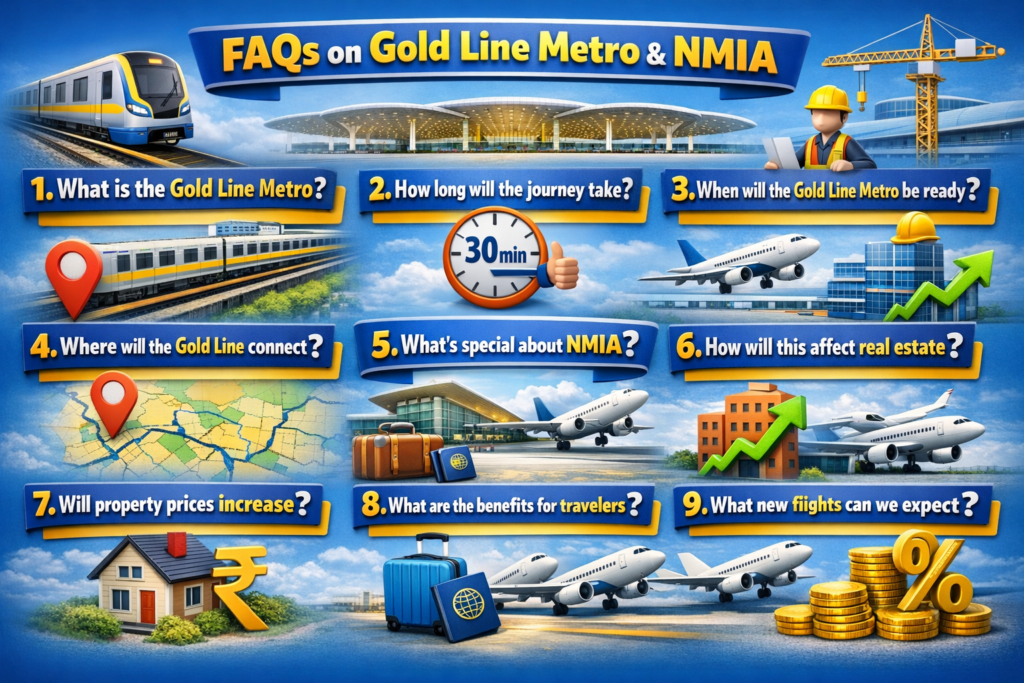
1. What is the Gold Line Metro?
The Gold Line Metro is a proposed high-speed metro corridor connecting Mumbai directly with Navi Mumbai International Airport (NMIA), significantly improving regional connectivity.
2. How much travel time will the Gold Line Metro save?
The metro will reduce travel time between Mumbai and NMIA to approximately 30 minutes, making airport access faster and more convenient.
3. What is Navi Mumbai International Airport (NMIA)?
NMIA is a new international airport being developed in Navi Mumbai to handle growing passenger traffic and reduce pressure on Mumbai’s existing airport.
4. How will Gold Line Metro benefit daily commuters?
It will offer faster, reliable, and congestion-free travel between Mumbai and Navi Mumbai, improving daily commuting efficiency.
5. How will NMIA impact Navi Mumbai’s development?
NMIA will boost economic growth, employment opportunities, infrastructure development, and global connectivity in Navi Mumbai.
6. What will be the impact on real estate prices?
Property values are expected to increase due to improved connectivity, infrastructure development, and rising demand for residential and commercial spaces.
7. Which locations will benefit the most?
Areas like Taloja, Panvel, Ulwe, Kharghar, Dronagiri, Roadpali, and surrounding zones will see major growth.
8. Is this a good opportunity for real estate investment?
Yes, infrastructure-led development typically ensures long-term capital appreciation and strong rental demand.
9. How will this help businesses and investors?
Better logistics, faster mobility, global connectivity, and access to a larger workforce will support business expansion.
10. Why is this project important for the Mumbai Metropolitan Region?
It strengthens regional integration, boosts economic growth, improves urban mobility, and transforms Navi Mumbai into a global connectivity hub.